HRV recording consistently scoring 26...
-
@cheetah694 said in HRV recording consistently scoring 26...:
@maszop Heartbeat is heartbeat. Heartrate variability is heartrate variability. It’s only that EliteHRV gives you the real number and the watch gives you a calculated approximation with an obscure formula. The comparison is not pointless. It shows how off the watch is from what it is supposed to show. You don’t have to act like a Suunto support clerk here. If the watch is not consistent for many people, then that’s just how it is. Everyone here has access to Google, Wiki, ChatGPT etc. and can figure out what is what easily.
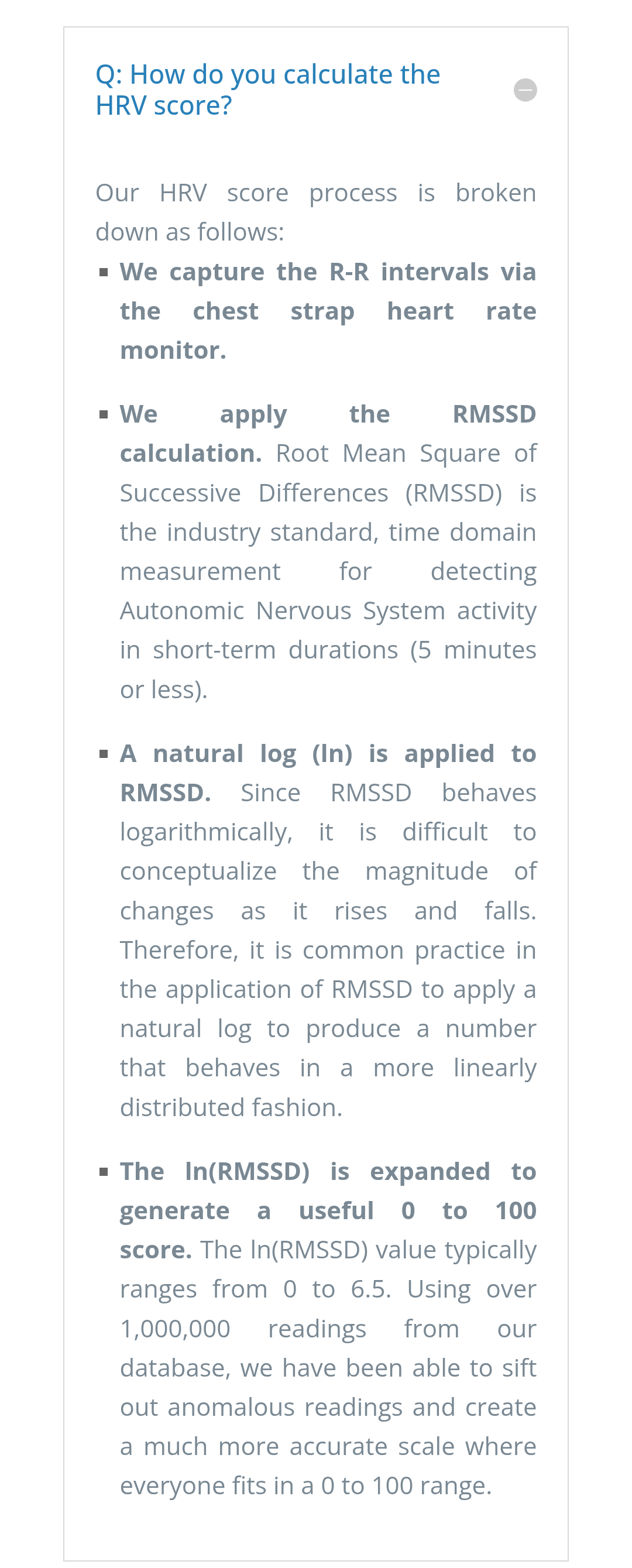
The HRV score from eliteHRV is not measured in milliseconds. It is their own defined unitless score and is not comparable to Suunto’s HRV rmssd measurement.
Attached is the definition of the eliteHRV score (from their FAQ)
-
I came here to say that measuring 26 (or any other number) every night sounds like a bug and should not happen, so probably should reach out to Suunto about that or try some other tool/watch to test it.
On the discussion part, I think it is common knowledge by now, that only reliable HRV measurement is in the morning and slightly worse but still reliable is overnight. And does not matter which number it is or what units it is used as (might be carrots per bucket), only trends matters.
I checked ads for eliteHRV app, so much nonsense haven’t seen for quite some time, a lot of “readiness score/stress level/prevent illness” type of things, that has 0 scientific proof. -
@TED77 said in HRV recording consistently scoring 26...:
@maszop said in HRV recording consistently scoring 26...:
@TED77 You’re measuring and comparing two different things. Hence the discrepancies.
Instead of wasting time on pointless comparisons, read up on how (and what) is measured and displayed in both apps.
Please explain your rationale of how they are completely different things? I’m very aware of what hrv is so no need for your patronising approach.
Just my two cents: You can “block” users, so you don’t waste time on rude and arrogant answers
-
@ChrisA but unfortunately you see the comments of blocked users when they are quoted…
-
@Gunnar that’s true - but at least it’s a bit less distracting
-
@Neil-McElroy My range is given as 72-85ms. I guess on average I get a 80,81 but obviously with some variation. Recently, after having couple of drinks, I got a 53ms in that night.
Couple of days before, I was feeling like I was about to get sick. When I checked HRV for the night before, I had 71ms. Arguably, it’s not that much below the minimum of the range but as I scored usually 80s I thought it matches the bad feeling I had on that day (might be confirmation bias).
-
@Mads-Hintz-Madsen That’s good to know. However the true rMSSD value in milliseconds is still shown in the app. That’s the big difference with what sport watches are doing. Elite HRV is fully transparent as to the data it records.
-
-
@maszop actually quite a useful thread there. Highlights the challenge comparing different methods. Indeed in elitehrv u can see the rmssd value which in theory should be the most relevant comparison to suunto. Again I believe the best option would be for suunto to enable users to take their own measurements through an app, allowing us to take a morning test ourselves. I’m a bit sceptical about overnight readings for a number of reasons but a chest strap measurement through the watch would be a really useful feature.
@maszop I get your point about comparing suunto and elitehrv score and u r quite right that they r different metrics, however the elite rmssd is a useful metric to use. I’m a bit embarrassed to admit, I did not realise elitehrv was shifting the measurement into their own scale for their score. So I learnt something new! -
@TED77 But generally, the number itself doesn’t matter, nor do these types of comparisons.
If the trend or graph is more or less the same in both tools, the difference in numerical values can simply be ignored.