your honest thoughts
-
@Stavrogin The OHR on the Suunto V1 and V2 is really good. I’ve never had the problems that some people here are writing about.
-
@Sportsfreund I agree. I do have a larger wrist though and maybe that is what helps. Even though I have a large wrist the V2 is heavy and feels like it is moving during runs. Again maybe this is why some get less than ideal HR. I like a snug fit when running.
-
@Stavrogin I also have large wrists, but I don’t find the V2 heavy. It’s a shame that some users are having so many problems.
-
@Sportsfreund I agree with you on the so many people thing. TBH my battery life is not great. I am not getting 20 days with the V2, but the GPS battery life is great. I lose about 10% a day with a 1 hour GPS and no HR activity. If they doubled that I would say okay, but…
What wrist strap are you using with your V2? I don’t notice it unless I have my Apex 4 on. Also wrist matters. When it is on my left wrist it feels less “moving”. Having said that it hasn’t affected HR readings when I do use the OHR.
-
@Stavrogin i use the original white/blue one.
-
What is the Apex 4 belt?
-
@Sportsfreund Apex 4 is a Coros watch.
-
said in your honest thoughts:
Let’s say I do have a preplanned route, but for whatever reason I have to take a quick detour while having the original route in view and merge into the original route a bit further. Again, that is not possible because as soon as I zoom out just a little bit all the trails disappear from the map. So I can no longer use the watch map as a visual reference. This is more common than you might think because detours might be needed for a number of reasons - trail closure, decommissioned trails that I didn’t know about at the time of planning, a need to refill water, etc.
Just one day after my comment I’ve run into the exact case I described above. Today during my trail run I’ve run into a sign that told me that the trail ahead was closed and wasn’t passable and I now had to find a way around. This is how it looked on the watch while I was trying to connect a few alternative trails and still keep an eye on the original route. I am just 150 meters from the route and already I have no help from the watch to find the way around.
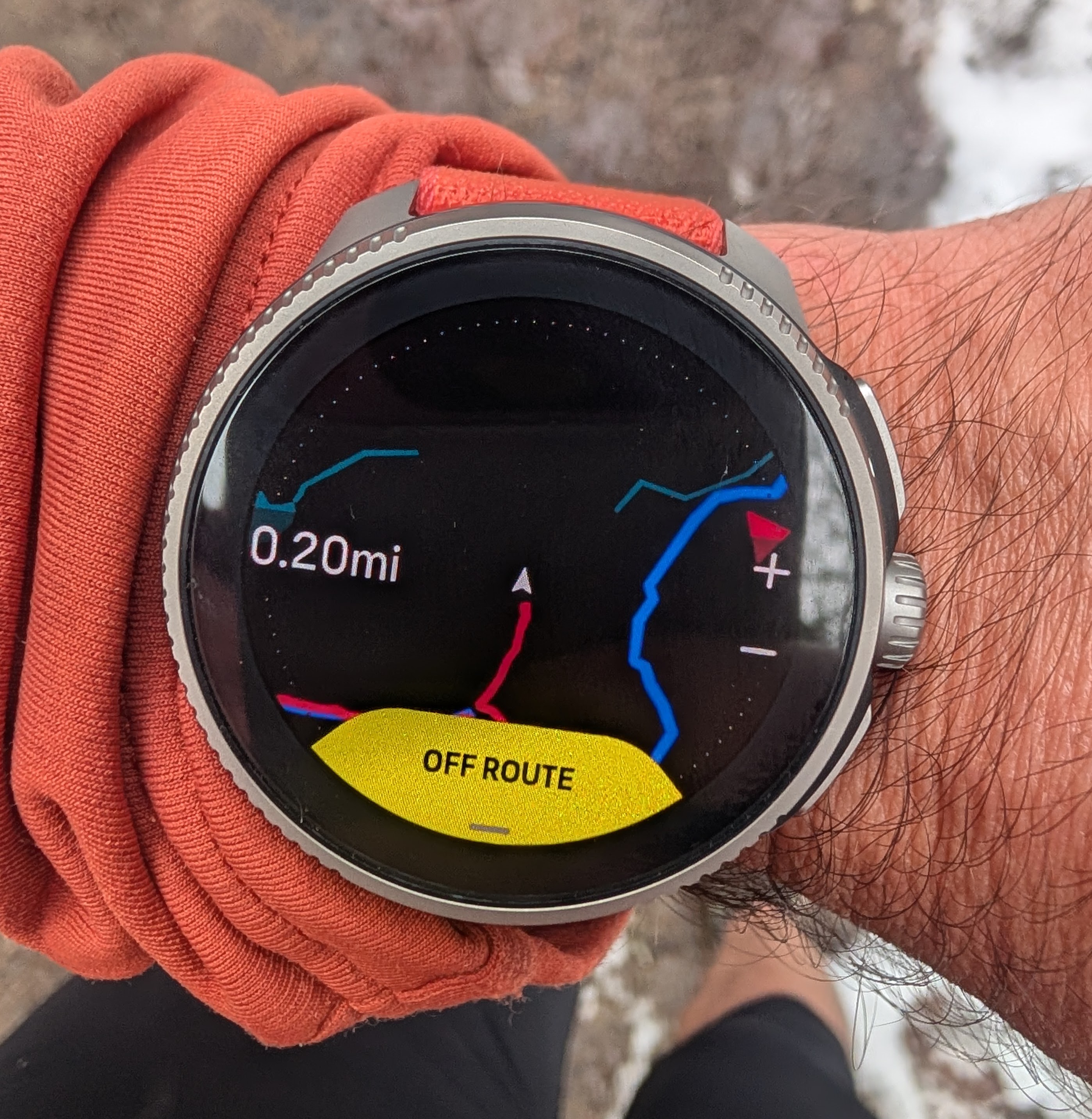
Also, adding salt to the injury, the crown stopped working (zooming the map) shortly after I took this picture and didn’t resume working until I had finished the run. Just perfect!
-
@sky-runner it just occured to me that Garmin set the position of “here” in the lower half, so you see more of the way ahead than the way behind you. Suunto sets “here” directly in the centre. Maybe a reason why Suunto’s maps rotate fast and Garmin slow…
-
@2b2bff My guess, there are two reasons.
-
Garmin devices have weak hardware. In particular, all current Garmin devices have only 5 MB of RAM - fast access operating memory where temporary data, such as rendered map data, can be stored. My guess is that because of that Garmin can’t cache a larger rendered part of map that works be needed for the rotation. In contrast, Suunto watches have additional 32 MB of RAM for the map data.
-
Garmin maps are far more detailed, which makes rendering more expensive in terms of battery power use, and that is probably why Garmin doesn’t pre-render maps in background.
So when you try to rotate a Garmin map it likely has to pull the data from the storage and then render it, which is slow. The storage access is the likely culprit.
-
-
@sky-runner That makes total sense. Suunto is a map with a route layer on top, Garmin is a totally different animal with real time routing and detail.