Race 2: GPS, cadence and distance accuracy vs previous Suunto models
-
@Ger43 said in Race 2: GPS, cadence and distance accuracy vs previous Suunto models:
@jjpaz So it’s increasingly clear that it’s simply a “software glitch” and that the hardware is working fine.
Is there a way to send these reports directly to the Suunto developers?
The error seems fairly obvious and verified…If you check athlete’s activities recorded with Race 2 the behavior is the same. So, I’m not alone…

-
@jjpaz said in Race 2: GPS, cadence and distance accuracy vs previous Suunto models:
@Ger43 said in Race 2: GPS, cadence and distance accuracy vs previous Suunto models:
@jjpaz So it’s increasingly clear that it’s simply a “software glitch” and that the hardware is working fine.
Is there a way to send these reports directly to the Suunto developers?
The error seems fairly obvious and verified…If you check athlete’s activities recorded with Race 2 the behavior is the same. So, I’m not alone…
I’m reluctantly thinking about returning it…I still have time.
But at this point, if I were to consider getting the Vertical 2, would I have the same problem? Or do you think the V2 is fine in this regard? -
Maybe @dimitrios-kanellopoulos can help. I too am getting less distance and lower pace compared to all other watches. somethimes as much as 170m per 10km (compared to AW3 that I already know is quite conservative).
-
@Ger43 I can’t tell you about the V2; I have the R2 and I’m currently testing it compared to my other watches. Try asking in the V2 subforum, although it seems to be more accurate in its GPS recordings.
-
This evening I tried an interval workout… 5x800…
I admit I’m completely lost… this evening, instead of cutting as usual, the Race2 showed me more distance than the Amazfit… already in the first 3km of warm-up, I noticed a pretty clear difference, which obviously affects my pace:
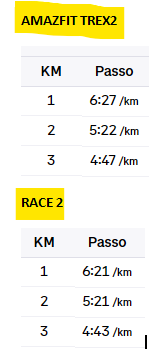
the pace on the repetitions also appears quite distorted between the 2 watches :
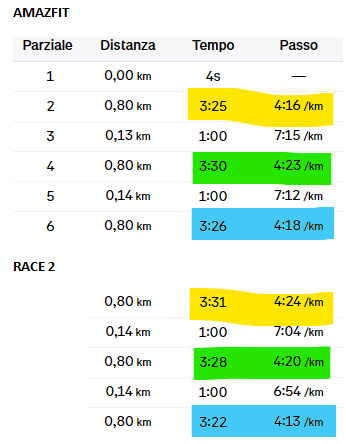
but other factors may have also influenced this, for example the START of the 2 watches were not aligned and in any case in general testing repetitions on 2 watches at the same time is not easy… but in the warm-up phase, on the other hand, the difference is quite evident.
The only difference compared to the previous two tests was that in this workout I had installed the map of my region (Lombardy, Italy). Do you think installing the map of the area where I run might have had some impact?
In any case, it now seems exaggerated in the opposite direction. Let’s always assume the Amazfit is telling the truth at this point…
Tomorrow I’ll do the same walking test as the other day. I want to see if the same behavior as the other day (about 10 meters less every 2 km) is confirmed or not.
-
@Ger43 for a bit more detail (and to rule out one possible factor), were the watches on the same wrist / arm? Was this session (including the warm up) on the track? Just wanting to check that the Suunto wasn’t on the outside (right, if running counterclockwise) wrist vs the Amazfit on the inside / left wrist, which could absolutely swing measurements this way.
-
@Finnjf said in Race 2: GPS, cadence and distance accuracy vs previous Suunto models:
for a bit more detail (and to rule out one possible factor), were the watches on the same wrist / arm? Was this session (including the warm up) on the track? Just wanting to check that the Suunto wasn’t on the outside (right, if running counterclockwise) wrist vs the Amazfit on the inside / left wrist, which could absolutely swing measurements this way.
Hi, so the warm-up session (the first 3km I posted) was done on the road, while the intervals were done on a loop in a park.
The Race 2 was on my left wrist (outside the track), the Amazfit on my right wrist (inside the track).
But as I said, I don’t consider the interval test very reliable because it wasn’t easy to test. In any case, even in the intervals, as well as in the warm-up, I noticed that the Race 2 recorded more meters than the Amazfit, and this difference was already noticeable during the kilometer.
So far, it’s always been the opposite, although never as marked as last night.
Is there a chance these anomalies will be noticed by a developer or someone at Suunto who can at least verify them?
These anomalies have been reported by multiple users; I find it absurd that no official communication has been received. -
@Ger43 You can analyze information from your raw data and compare (export JSON or FIT files). That’s the best way to know which GPS points have recorded your watches and what’s the raw distance vs the official ditance showed in watch.
-
@Ger43 You can also review your activity data in https://www.sports-tracker.com/ (the old Suunto App website).
In my case, Sport Tracker analysis: Summary shows 10,20km (official distance showed by Race 2) but GPS data and Laps distances show 10,34km as total recorded distance.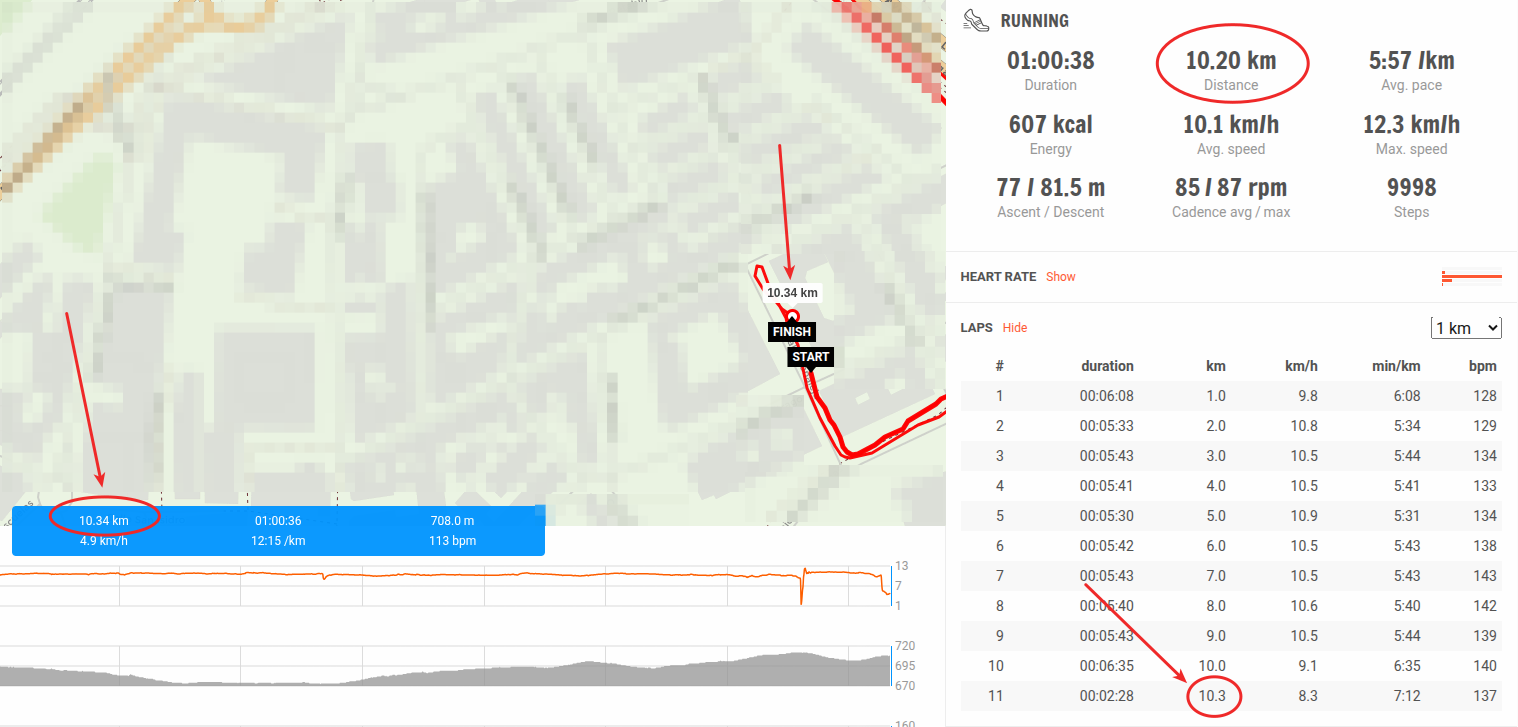
With this data:
Official Distance (Device Summary): 10.201 metros
RAW Distance (GPS Points Summation): 10.334 metros
Algorithmic Reduction (Clipped): -133 metros (1.29%)Official Pace (Reloj): 5:56 min/km
Actual GPS Pace (RAW): 5:52 min/km
Pace reduction: +4seg/kmWhy Race 2 is shortening/filtering the distance? Other Suunto watches are more faithful to GPS data. That’s my question, because it seems obvious that Race 2 records GPS raw data correctly, at least is very similar to other watches but, postprocessing is more agressive.
Suunto Vertical Titanium Solar, Suunto Race 2 Ti & Suunto Wing.
-
It’s raining in Milan today, so I thought I’d test it by placing both watches on my car’s dashboard and setting a cycling activity on both so I could travel at least 30 km/h

This test also confirms everything I said above, that the Race 2 measures meters…here we’re roughly 30 meters out of 5,000.
Amazfit: 5,070 m
Race 2: 5,040 mThis time, however, it seems that the difference is also in the raw file. I uploaded in “Quantifier” website the Race 2’s json file and the Amazfit .FIT file, and it seems that the 5,040 m are also in the json file this time.

My fear is that if I were to return it to Amazon and upgrade to the Vertical 2, I might find myself in the same situation. At the same time, I don’t want to buy the Race1 or Vertical1 models, which are still a step behind the Race2, and aesthetically, I really like the Race2.
This flaw, however, is unacceptable, so I don’t know what to do: wait, perhaps, for an update that permanently fixes this problem, or return it?
-
@jjpaz Just speculating here but there might be some other metric taken into account. Usually when dealing with signals there’s the Signal to Noise Ratio (SNR) and maybe there is no difference in FW but the Race 2 has lower SNR and discards more points?
-
@EzioAuditore Good point, because preciselly I noted that distance difference is higher in bad conditions (turns, buildings, forest,…) and lower in good conditions. Analyzing GPS quality data in several Race2 and Vertical JSON files, this is the result:
- Analysis of Turns and Trajectory
By comparing the GPS coordinates second-by-second during change-of-direction points:
Wismar (Race2 17,181 m): It tends to slightly “clip” or “cut” the corners. Its smoothing algorithms seem to interpret rapid direction changes as potential noise, drawing a flatter line between data points.
Rostock (Vertical 17,252 m): It records a trace that is more faithful to the actual path. In 90° or 180° turns, the Rostock accumulates between 2 and 4 extra meters per major turn compared to the Wismar.
- Signal Quality in Critical Zones
I looked for moments where the EHPE (Expected Horizontal Position Error) rose above 4.5 meters on the Wismar device:
“Accordion” Effect: In sections where the pace dropped sharply or there were technical stops, the Wismar activated more aggressive “auto-pause” or point-reduction filters.
Sampling Frequency: The Rostock (Orca hardware) appears to keep a slightly more consistent sampling rate during high-intensity moments, allowing it to “draw” the micro-variations of the route more accurately.
Technical Conclusion
The Rostock (Orca_RevC1) proves to be slightly more precise in this specific test because:Its peak EHPE was lower during maneuvers.
Its Path Reconstruction algorithm is less aggressive, avoiding the “corner-cutting” effect seen in the Wismar (Sailfish_RevA1).
So, according to all my tests and analysis, seems that Race 2 algorithm behavior is different… Or is better and other watches overstimate distances or is poorer and Race 2 is underestimating…
- Analysis of Turns and Trajectory
-
An interesting read for all of those suffering GPS distance errors which equate to 1-2% of the total distance travelled.
Even Garmin explains that discrepancies can occur!
Top FAQs About GPS Distance, Speed, and Pace Accuracy With Garmin Devices
I work in metrology and know that comparing different devices can lead to all sorts of confusion and doubt, if a traceable standard is not used as a reference. Unfortunately, neither Garmin, Polar, Suunto or Corus make (or even claim to make) such a device.
I guess it would be interesting to understand how the new watches calculate distance compared to the old ones. It seems that most devices tend to overestimate distances, and maybe some logic has been applied to try and reduce errors which occur due to this.
Suunto Race Titanium
Suunto Ambit3 Peak
Polar H10
Polar OH1 -
@wakarimasen
You will break some dreams that some devices are having THE truth and their 10m more per 5km…SSU (retired), SV1, SV2
Wife : S9PP
SA: Always the latest beta :)
Android + Galaxy S205G -
@Mff73 said in Race 2: GPS, cadence and distance accuracy vs previous Suunto models:
@wakarimasen
You will break some dreams that some devices are having THE truth and their 10m more per 5km…I can only apologise. Reality can be problematic

-
@Mff73 They are destroying our ego!

This topic is simply to learn a little more about how the gadgets work, and it’s very interesting.
Let’s use and enjoy the watches, that’s the important thing. -
@wakarimasen That is a good read (the first link), but it needs to be pointed out that it is from 2016. At this point, most of our devices have moved on from “recreational grade” to “mapping grade” since dual-band technology allows for accuracy to “tell us which side of the road we are on.”
I’d agree with those who argue that it isn’t important to quibble bout a 1-2% discrepancy in distance. The issue being discussed here, though, is that there is a clear and repeatable difference in distance calculation between devices from the same company that one would think are all using the same technology and algorithms (which apparently they aren’t).
-
@duffman19 said in Race 2: GPS, cadence and distance accuracy vs previous Suunto models:
@wakarimasen That is a good read (the first link), but it needs to be pointed out that it is from 2016. At this point, most of our devices have moved on from “recreational grade” to “mapping grade” since dual-band technology allows for accuracy to “tell us which side of the road we are on.”
I’d agree with those who argue that it isn’t important to quibble bout a 1-2% discrepancy in distance. The issue being discussed here, though, is that there is a clear and repeatable difference in distance calculation between devices from the same company that one would think are all using the same technology and algorithms (which apparently they aren’t).
I think we may be ‘agreeing violently.’
From my previous post:
I guess it would be interesting to understand how the new watches calculate distance compared to the old ones. It seems that most devices tend to overestimate distances, and maybe some logic has been applied to try and reduce errors which occur due to this.Nevertheless, I would be very surprised to learn that ‘official’ mapping is carried out by someone wearing a Suunto, Garmin, Polar or Corus device, and declaring the data ‘accurate.’
Suunto Race Titanium
Suunto Ambit3 Peak
Polar H10
Polar OH1 -
@wakarimasen Please, no “violence” here

The origin of the thread was “Have you noticed if the new hardware measures less distance in activities than the previous watches?”.
Just a question, just a comparison between behaviors of different watches with “similar” hardware and software.
The topic wasn’t (at least primarily) about discussing (or complaining about) GPS technology or professional map creation, although any information is welcomed to learn about it (Telecommunications Engineer here, I know some things about GPS technology ). -
@wakarimasen said in Race 2: GPS, cadence and distance accuracy vs previous Suunto models:
An interesting read for all of those suffering GPS distance errors which equate to 1-2% of the total distance travelled.
GPS mileage discrepancies
That post is from 2016 when single band GPS was the only option and the accuracy was rather mediocre. Around 2022 there was a real breakthrough in GNSS accuracy, and now even cheap watches easily achieve 1 meter accuracy for a single position when using multi-system multi-band GNSS. A consistent bias of 0.5-1% in the distance measurement is no longer a random thing caused by GPS but a systemic error caused by the algorithm.
Furthermore, as has been explained above, the actual GPS distance remains accurate. The bias is introduced in post-processing, likely when fusing accelerometer and gyroscope data with the GPS data. I bet there is no such bias when doing a cycling activity and it applies only to walking or running. I know that Garmin does a similar thing for walking and running. They want to continue measuring the distance when GPS reception is lost, for example when briefly going through a tunnel or under an overpass, or near tall buildings. So the sensor fusion is continuously performed and that may make the measured distance different from the GPS distance.
Suunto: Ambit, Ambit 3 Peak, 9 Baro, Race S, Race Ti
Garmin: Forerunner 210, Forerunner 610, Fenix 6X, Fenix 7X Ti