HRV recording consistently scoring 26...
-
@maszop aren’t both measuring RMSSD?
-
@OutdoorMan yes they are.
-
@OutdoorMan Among other things, in different stage of sleep.
Comparing numerical values is pointless – what matters is the trend. This is the point of HRV monitoring. Raw numerical data (without context) is useless. -
Hello again,
thanks to all that have replied.Just to clarify and avoid any more less than helpful posts - I have already read up on HRV, understand what and how it is measured across different devices.
I agree on HRV being personal and to an individual and to only look on it as a trend.
All that being said - mine is still reading 26 every night, it doesn’t vary, despite heavy training days VS non training days, poor sleep VS great sleep and alcohol VS no alcohol - it should.
I’m not trying to compare to Garmin but it was clear how these activities impacted the score (trend).
Does anyone know if this is a known issue and something that is being looked at from a software update POV?
Many thanks,
Neil.
-
@Neil-McElroy I’d be very interested in any real answer from suunto on this too.
As i mentioned before, i believe there is an issue in the suunto algorithm and this may be something that causes variations from user to user or watch to watch. Whilst its correct that the trend generally is the more useful indicator an absolute and accurate measurement of the metric is also important. The calculation is and should be a standardised one therefore it should be very close no matter what measures it. It is a relatively simple calculation. The device should measure the RR interval - RR being the time between each R wave (the upspike on an ECG). This time should be measure in milliseconds (not simply a single decimal of seconds) and ideally as accurately as possible. Over a period of measurements each of these will vary of course. The Root Mean Square of successive differences -RMSSD is then calculated from the accumulation of these measurements.
RMSSD: Calculates the square root of the average of squared differences between adjacent RR intervals.This is not desperately complicated maths however can and will be affected by measurement accuracy. Even very small disturbances will cause interference and noise which is why optical devices use an algorithm to attempt to cancel out this noise and correct for it. Depending also on the accuracy and type or sensor being used, the precision of the RR intervals will be directly affected. Think one decimal place in measurement precision will imply a 10% measurement accuracy deviation.
If the suunto algorithm is too aggressive it could be dumbing down the measurement accuracy and precision. Similarly if its not truly measuring tomthr millisecond it will be well off. This will not only affect the overall mathematical calculation but also the trend, hence the importance of an actual and realistic measurement not just a trend. There are many other variables in this including skin type, hair, placement of the device, sweat, movement, device calibration, so some form of algorithm is needed however my feeling is that either an element of quality control in devices is lacking or the algorithm is too inflexible. I’d like to see suunto give users more control of this, more information about how it is working and allow users to perform their own hrv readings to give more control over its usage.
-
@TED77 I’ve never had a problem with HRV. It always pinpoints differences perfectly (illness, alcohol, fatigue, excellent fitness, etc.).
-
HRV seems to be working for me too, for me abnormal HRV correlates with alcohol, bad nights etc
-
How much variance do you get between good and bad nights?
-
@TED77 Thank you for mentioning the Elite HRV app. I’ve long had a feeling that those HRV readings from the OHR sensor are highly inaccurate. And it is so! A 9PP was showing HRV in the 20-30 range for my girlfriend, causing some unease as if there is something wrong with her cardiovascular system. But Elite HRV is showing that the actual value for her is 60+ putting her in the upper half for her age group. For me the gap is smaller, but on certain days the watch is way off. I’m now using the watch only to track my workouts. A two year practice has shown it’s misleading for anything else.
-
@maszop It could also be that the watch is telling you are fatigued and you start feeling fatigued. This is a very slippery territory. I wager that the same athlete on a race day, one with a watch telling him he is fatigued and one with a watch telling him he is in excellent shape, will show different race time. A fitness watch can play tricks on people without them even noticing it. It’s called placebo effect, and it’s absolutely real.
-
@cheetah694 Even a small beer shows up in my HRV results. Or I even notice signs of a cold before I even realize it.
As for the EliteHRV comparisons, they’re pointless and you’re drawing the wrong conclusions. They’re not measuring the same thing.
Of course, that doesn’t mean it works perfectly for everyone. It works very well for me. -
@maszop Heartbeat is heartbeat. Heartrate variability is heartrate variability. It’s only that EliteHRV gives you the real number and the watch gives you a calculated approximation with an obscure formula. The comparison is not pointless. It shows how off the watch is from what it is supposed to show. You don’t have to act like a Suunto support clerk here. If the watch is not consistent for many people, then that’s just how it is. Everyone here has access to Google, Wiki, ChatGPT etc. and can figure out what is what easily.
Suunto 9 Peak Pro
-
@cheetah694 Maybe you should read about what, when and how is measured instead of engaging in pointless discussions.
And not in ChatGPT, but in the documentation.
And I am probably the last person on this forum who can be called a Suunto support clerk.
-
@cheetah694 said in HRV recording consistently scoring 26...:
@maszop Heartbeat is heartbeat. Heartrate variability is heartrate variability. It’s only that EliteHRV gives you the real number and the watch gives you a calculated approximation with an obscure formula. The comparison is not pointless. It shows how off the watch is from what it is supposed to show. You don’t have to act like a Suunto support clerk here. If the watch is not consistent for many people, then that’s just how it is. Everyone here has access to Google, Wiki, ChatGPT etc. and can figure out what is what easily.
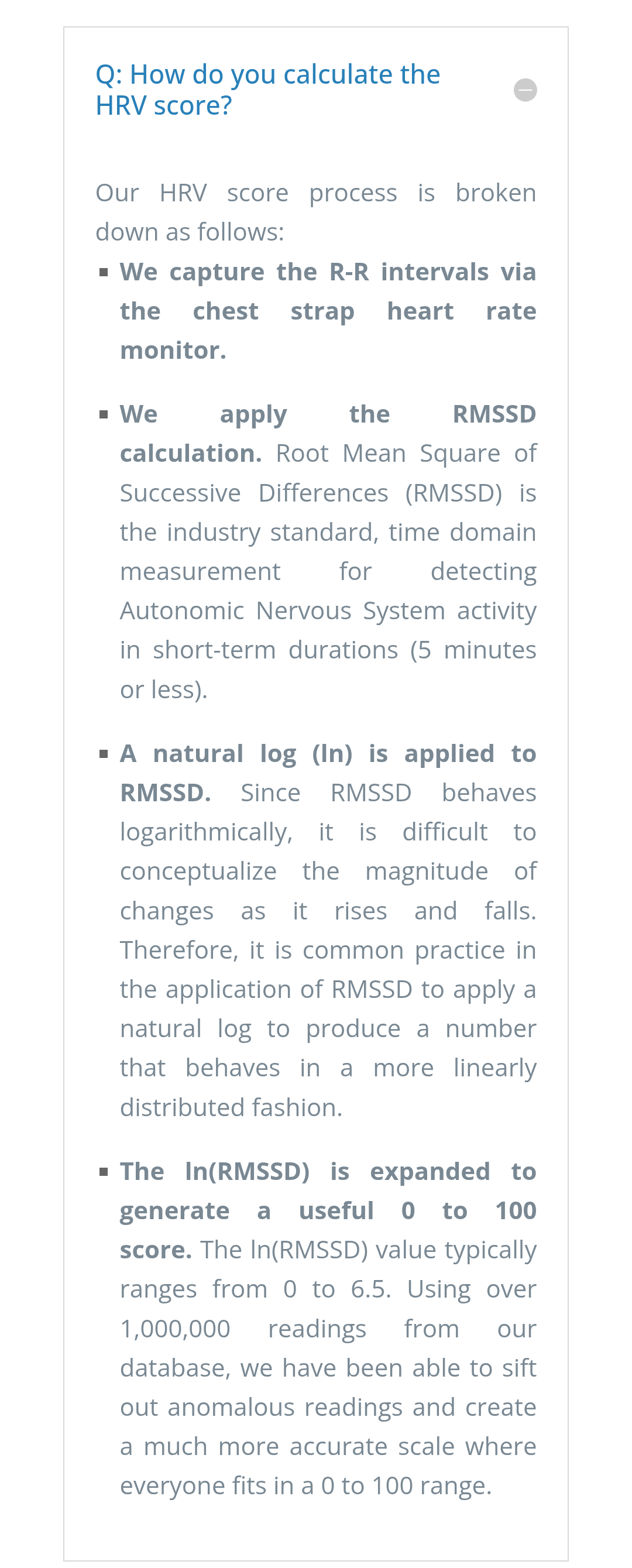
The HRV score from eliteHRV is not measured in milliseconds. It is their own defined unitless score and is not comparable to Suunto’s HRV rmssd measurement.
Attached is the definition of the eliteHRV score (from their FAQ)
-
I came here to say that measuring 26 (or any other number) every night sounds like a bug and should not happen, so probably should reach out to Suunto about that or try some other tool/watch to test it.
On the discussion part, I think it is common knowledge by now, that only reliable HRV measurement is in the morning and slightly worse but still reliable is overnight. And does not matter which number it is or what units it is used as (might be carrots per bucket), only trends matters.
I checked ads for eliteHRV app, so much nonsense haven’t seen for quite some time, a lot of “readiness score/stress level/prevent illness” type of things, that has 0 scientific proof. -
@TED77 said in HRV recording consistently scoring 26...:
@maszop said in HRV recording consistently scoring 26...:
@TED77 You’re measuring and comparing two different things. Hence the discrepancies.
Instead of wasting time on pointless comparisons, read up on how (and what) is measured and displayed in both apps.
Please explain your rationale of how they are completely different things? I’m very aware of what hrv is so no need for your patronising approach.
Just my two cents: You can “block” users, so you don’t waste time on rude and arrogant answers
-
@ChrisA but unfortunately you see the comments of blocked users when they are quoted…
-
@Gunnar that’s true - but at least it’s a bit less distracting
-
@Neil-McElroy My range is given as 72-85ms. I guess on average I get a 80,81 but obviously with some variation. Recently, after having couple of drinks, I got a 53ms in that night.
Couple of days before, I was feeling like I was about to get sick. When I checked HRV for the night before, I had 71ms. Arguably, it’s not that much below the minimum of the range but as I scored usually 80s I thought it matches the bad feeling I had on that day (might be confirmation bias).
-
@Mads-Hintz-Madsen That’s good to know. However the true rMSSD value in milliseconds is still shown in the app. That’s the big difference with what sport watches are doing. Elite HRV is fully transparent as to the data it records.