VO2Max and walking/hiking
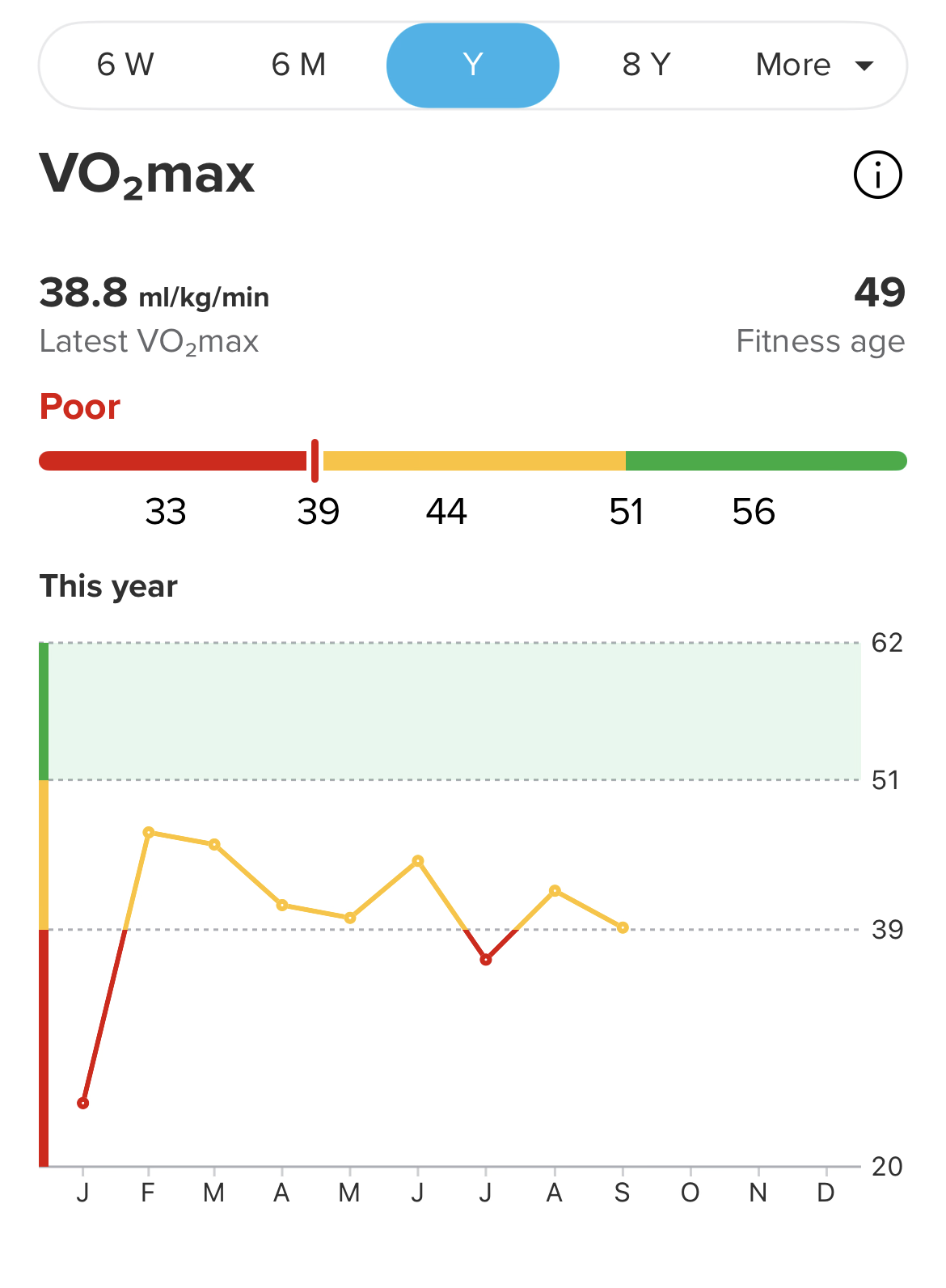
-
@Stavrogin i configured it same way as i had on Suunto 5.
Rest HR 60
Max HR 184
Zone 1 <133
Zone 2 <142
Zone 3 <151
Zone 4 <160
Zone 5 >160While walking i am usually in zone 1 and 2. I don’t do much hiking lately, but today short 5km hike , but intensive i was 19% in zone 5, 17% in zone 4,… and 46% in zone 1.
70% is 128bpm, so i reach it for at least some time everytime.
-
@Tomas5 So are you using Hiking or Walking activity? Those are two different things. While walking can generate VO₂ max, Hiking activity does not. Since VO₂ max calculated from walking is questionable at best, I never use walking activity. Try running or trail running if you can, but trail running will generally produce lower score than flat road running or track running. Ideally, there should be an option to disable VO₂ max in trail running.
-
@Squirrel i do both walking and hiking. I don’t run for at least 6-7 years. But still it was working with Suunto 5, i can’t tell how accurate it was but it measured something.
-
@Tomas5 You can disregard all hiking activities as they do not calculate VO₂ max. But it can depend on when you first used Walking activity on this new watch and how many times you used it, before you get VO₂ max score. For me, it took over a month of running to get VO₂ max. Some people get the score sooner, no idea what it depends on.
-
@Tomas5 I would not trust ANY device to compute a VO2M from walking or hiking. Why do you think athletes do lab tests? Sorry but I don’t think devices should do this under any circumstances as the result has to be completely invalid.
-
@Brad_Olwin to be honest i don’t need this metric. But if i have device with some features, i like them all to work correctly regardless i need them right now or not. Based on what you say, i would prefer if suunto really does just metrics that is capable of duing in right way. It would reduce number of features and helped focus developers work on rest of features that really works.
Is there any way to hide metrics that doesn’t work from app? I found lot of customization but not sure if this is possible.
-
This is from SR2 manual: Your aerobic fitness level is defined as VO₂max (maximal oxygen consumption), a widely recognized measure of aerobic endurance capacity. In other words, VO₂max shows how well your body can use oxygen. The higher your VO₂max, the better you can use oxygen. The estimation of your fitness level is based on detecting your heart rate response during each recorded running or walking workout. To get your fitness level estimated, record a run or walk with a duration for at least 15 minutes while wearing your Suunto Race 2.
For a walk under certain conditions SR2 should provide VO₂max estimation. Even if not precise as in lab, for someone at the beginning of fitness journey it could be a good indicator of progress and also a motivation.
App: beta
Phone: Iphone
iOS -
I never understood why walking / hiking is producing vo2max. I noticed that when Race S once calculated that when my wife couldn’t figure out how to get a vo2max reading for running. It took one walk to finally get it. And since then also running calculated vo2max. For me only Baro 9 produced vo2max while hike, no other watch, and I hated it

-
@dulko79 thats even more confusing as i did mostly walks with Race 2. Only few hikes, and just few bike rides.
Some say hiking doesn’t count, but my older Suunto 5 few times rapidly changed fitness age after hiking and if i am correct it is related to VO2Max.
-
@OutdoorMan i don’t understand why running should, walking/hiking shouldnt. I just know i don’t run because problems with knee for a long time. But still my previouse suunto watch (S5) did calculate this. How correct value was? I don’t know, but i know OHR didn’t worked well on S5 for me (lot of spikes and sometimes 20% of excercise it dropped to half of actual HR or it jumped to double which was even worse (like 200bpn while walk). So i assume this was really not calculated correctly since it is based on heart rate.
-
@Tomas5 how many people do you know who train to improve their vo2max by walking? By definition it’s maximal oxygen consumption and maybe I am uneducated, but you improve it by reaching a certain percentage of you max HR, by running/cycling intervals, hiit, anything that brings your heart rate up for a certain amount of time. At least this is how I do it. Certainly not by walking. Maaaybe hiking uphill. For me measuring it for sports other than running or cycling doesn’t make sense. But that is my opinion, I am not arguing.