Race 2: GPS, cadence and distance accuracy vs previous Suunto models
-
@duffman19 Thanks for your comment.
Yes, I take the AI’s results with a grain of salt. The thing is, what it indicates aligns very closely with my feelings and what I’ve seen in Race 2.It’s clear that nowadays "sport/smart"watch users are more concerned with the accuracy of the optical sensor, clean tracks, health features and watchfaces, rather than the absolute precision of GPS metrics like they were a few years ago. DC_Rainmaker himself no longer shows distance comparisons in his reviews to test GPS accuracy between watches, only images of the tracks to see if they are clean.
We now take for granted that this data has reached an incredible level of accuracy, that all brands are there, and people are looking for other things.
In my case, it’s a bit of “occupational hazard” and a desire to investigate further and learn during the process.Maybe with more activities the GPS+Acelerometer twin will be more aligned with my Vertical and RaceS data. I’ve been using Race 2 only for two weeks now. We’ll see how evolves.
Hope you find this thread interesting

-
After analyzing several activities using two watches simultaneously for comparison and running all the raw data through a pair of AIs, these are the conclusions obtained: aggressive post-processing filter within the FusedSpeed algorithm or a calibration bias in the Race 2 accelerometer.
It seems that Race 2 is more agressive/conservative than previous Vertical/RaceS algorithms.
FYI, If you feel like reading for 1 minute:
TECHNICAL REPORT: Distance and Cadence Discrepancy (Suunto Race 2)
Subject: Systematic Underestimation of Distance and Cadence: Suunto Race 2 vs. Suunto Vertical/Race S (FusedSpeed/Accelerometer Algorithm Analysis).- Problem Description: After conducting multiple comparative tests (dual-watch setups, wearing both devices on the same wrist to eliminate arm-swing variables), a consistent pattern of distance underestimation has been identified in the Suunto Race 2 (49mm) compared to the Suunto Vertical and Suunto Race S. These tests have been carried out in various activities and, in all of them, the difference in distance ranges between 90-160m in 10km of activity.
The evidence suggests that the discrepancy does not originate from the GNSS sensor itself (the recorded GPS tracks are accurate), but rather from an overly aggressive post-processing filter within the FusedSpeed algorithm or a calibration bias in the Race 2 accelerometer.
- Comparative Test Data example (Same Wrist - Jan 15th, 2026):
Course: Urban circuit with frequent turns and 4 moderate pace intervals.
GPS Mode: Performance / Dual-Band (All systems) on both devices.
FIT File Distance (Race 2): 9.55 km
FIT File Distance (Race S): 9.62 km
Calculated GPX Distance (Raw coordinates): 9.62 km
- Key Technical Findings:
GPX vs. FIT Gap: While the Race S and Vertical FIT distances align almost 100% with the distance calculated by the sum of latitude/longitude coordinates (GPX), the Race 2 shows a loss of ~70 meters. This confirms that the device is discarding real GNSS-provided distance based on conservative accelerometer readings.
Cadence and Stance Time: Despite being on the same arm, the Race 2 consistently reports a higher cadence (174 spm vs 172 spm in Race S). This discrepancy suggests that the Race 2’s heavier chassis (49mm) might be affecting impact detection thresholds, causing the software to misinterpret movement dynamics.
Pace Transition Smoothing: The distance loss is most significant during pace changes and sharp turns. The Race 2 applies a higher level of “smoothing,” often treating legitimate acceleration or cornering as sensor noise, resulting in “shortened” tracks.
- Inquiry for Support: Is there a known calibration offset for the Race 2 (49mm) accelerometer? Are there plans for a firmware update to align the FusedSpeed sensitivity of the Race 2 with the more transparent and accurate performance observed in the Suunto Vertical and Race S models?

-
My Suunto Race 2 Technical Test - Final comments:
I have conducted a side-by-side analysis of the Suunto Race 2 against the Suunto Vertical and Suunto Race S across multiple activities during more than 2 weeks.
Suunto Race 2 systematically under-reports total distance by 0.5% to 1.5% compared to reference devices (Suunto Vertical and Suunto Race S).
Analysis of RAW FIT files confirms that this is not a GNSS reception issue. The Race 2 records valid GPS coordinates but seems to discard valid distance data during post-processing. In every activity analyzed, the Suunto Race 2 records a “Session Summary” distance that is significantly lower than the mathematical sum of its own recorded GPS coordinates.
Pattern: The device records the correct path (lat/long points) but the internal software filters out valid distance.
Example: The Race 2 RAW file contains GPS coordinates summing to 11.35 km, yet the final session summary displays 11.20 km.
Comparison: The Suunto Vertical and Race S show a near-perfect match (99.9% accuracy) between their GPS point sum and the displayed distance.The Race 2 consistently reports a higher average cadence than the reference units, likely due to hardware inertia or accelerometer sensitivity.
Pattern: Race 2 reads +2 to +4 spm (steps per minute) higher than Vertical/Race S in every activity.
Consequently, the device systematically calculates lower power (-7 Watts) and shorter distance (-0.7% to -1.5%) compared to reference devices (Vertical/Race S), despite identical GPS tracks.Do you have this difference between devices? Is the current performance acceptable for a flagship device when compared to the older Vertical and the cheaper Race S?
Suunto Vertical Titanium Solar, Suunto Race 2 Ti & Suunto Wing.
-
 J jjpaz referenced this topic on
-
@jjpaz No comment about the distance, but when I first moved to Race S from Garmin Fenix 7X I noticed that it reported noticeably fewer steps than Garmin.
Later Race / Race S step accuracy when running was improved but my impression was that it still remained too low, so perhaps Race 2 counts steps more accurately.
Here is an example from a recent 14 mile run on trails. The number of steps is 23886. Historically, when running on flat road I did about 1600 steps per mile and on technical trails - closer to 2000 steps per mile. When walking - also about 2000 steps per mile. This trail run was more runnable but still with a decent amount of ascent, some stairs and some walking sections, etc. 1700 steps per mile feels a bit short.
-
@sky-runner said in Race 2: GPS and distance accuracy vs previous Suunto models:
@jjpaz No comment about the distance, but when I first moved to Race S from Garmin Fenix 7X I noticed that it reported noticeably fewer steps than Garmin.
Later Race / Race S step accuracy when running was improved but my impression was that it still remained too low, so perhaps Race 2 counts steps more accurately.
Here is an example from a recent 14 mile run on trails. The number of steps is 23886. Historically, when running on flat road I did about 1600 steps per mile and on technical trails - closer to 2000 steps per mile. When walking - also about 2000 steps per mile. This trail run was more runnable but still with a decent amount of ascent, some stairs and some walking sections, etc. 1700 steps per mile feels a bit short.
About steps/cadence: in all my activities during these 2 weeks, Race 2 have measured less steps and higher cadence than Vertical and Race S and I think there’s something wrong. Both watches in same arm.
For example, yestarday’s activity:
- Race 2: 9,02km. 8736 steps. 87rpm.
- Race S: 9,08km. 8743 steps. 86rpm.
Saturday’s activity:
- Race 2: 11,21km. 10639 steps. 87rpm. 1h02’38".
- Vertical: 11,26km. 10647 steps. 85rpm. 1h02’37".
So, taking this into account, with same distance and duration, how can I take less steps and faster (higher cadence)? I have asked Gemini about this inconsistency:
"The data recorded by the Suunto Race 2 during the 62:38 session shows a critical mathematical inconsistency between ‘Total Strides’ and ‘Average Cadence’.
The device recorded a total of 10,639 steps. Mathematically, over a duration of 62.63 minutes, this results in an actual cadence of 169.8 spm (84.9 rpm). However, the watch reported an Average Cadence of 87 rpm (174 spm). For this average to be correct, the device should have registered approximately 10,900 steps, which is not the case.
This proves that the Suunto Race 2 is not deriving its ‘Average Cadence’ from the ‘Total Strides’ counter. Instead, it is using incorrectly averaged instantaneous values. This ‘ghost cadence’ (87 rpm vs. the real 85 rpm) directly misleads the FusedSpeed algorithm: the watch ‘believes’ the runner is taking more steps than they actually are, assumes a much shorter stride length, and consequently applies an artificial reduction to the total distance (11.21 km vs. the 11.26 km recorded by the Suunto Vertical)."
WOW
-
@jjpaz I am really impressed with the work you have done. I had posted in Reddit thread about the conservative distance race 2 is giving, ie I am also getting about 80-130m distance shorter for a 10km run compared to coros pace pro and apex 4. I used to have both race S and Race and both actually have very similar distances logged and are longer by about 80-130m compared to Race 2 (for a 10km run). While I am not disputing that Race 2 could be more accurate in distance, I do think that there could be a smoothing effect in logging of distance . It’s not a big deal but it does bug me quite abit. Sure hope a software update will help resolve this .
-
@leafs93 said in Race 2: GPS, cadence and distance accuracy vs previous Suunto models:
@jjpaz I am really impressed with the work you have done. I had posted in Reddit thread about the conservative distance race 2 is giving, ie I am also getting about 80-130m distance shorter for a 10km run compared to coros pace pro and apex 4. I used to have both race S and Race and both actually have very similar distances logged and are longer by about 80-130m compared to Race 2 (for a 10km run). While I am not disputing that Race 2 could be more accurate in distance, I do think that there could be a smoothing effect in logging of distance . It’s not a big deal but it does bug me quite abit. Sure hope a software update will help resolve this .
Yes, Race 2 seems more conservative than Vertical or Race S in terms of distance calculation. These two are more confident in GPS points and cañculated distance is close to the GPS raw distance. Maybe they are a bit generous. Race 2 filters/discard around 1% of the raw distance. What’s more accurate? May be perfection is in the middle?
Have you moticed difference in cadence? Do you have more cadence (+2rpm) with Race 2 compared to other watch (wearing both in same arm)?
Now I’m training only with one watch, Race 2, and don’t compare to other.
-
@jjpaz My recent experience with Race 2 (and the last 2 firmware versions) confirms your findings. When running on the same route, I came to know where to expect the lap marks and I noticed that Race 2 has some delays, and the whole distance counted at the end of the activity is less than what I had on the same route with various other devices (AWU/AWU3/Vertical 1/Epix Pro/Fenix 7x).
I looked into the fit files exported and that confirms your data: the GNSS distance is 1-2% higher than what I see on the screen. This seems to be the result of the recent adjustments in the firmware, the look of the track visually seems ok but I’m a bit annoyed that I’m getting lower distance and I can’t trust the device as I did in the past. Suunto may have some limitations when compared with Garmin high end watches (or the smartness of Apple Watch Ultra) but at least the GNSS and basic measurements were top (until now). Hope for a change in the next updates, otherwise I’m tempted to change device for another brand. Let’s see if the problem is at least acknowledged …
-
@Liviu-Nastasa If the difference is 1-2% on a road, I wonder what it would be on a twisty trail.
-
@sky-runner
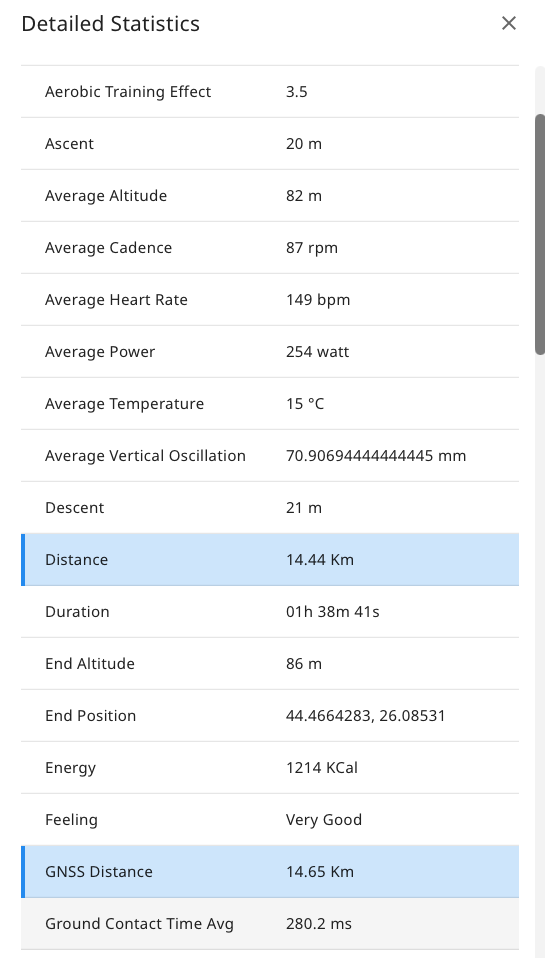 I run today with a friend wearing a Garmin Epix Pro, his watch measured 14.6km … mine shown 14.44km … the difference seems to be 1.43%.
 -
@Liviu-Nastasa said in Race 2: GPS, cadence and distance accuracy vs previous Suunto models:
@sky-runner
I run today with a friend wearing a Garmin Epix Pro, his watch measured 14.6km … mine shown 14.44km … the difference seems to be 1.43%.160m difference in ~14km. Today mi Race 2, 120m less than Vertical in 12,2km. (The sistematic ~1% difference).
You can try “distance correction” in Strava (GPX ra distance) and see the difference. May be it wiil be more close to Garmin final distance.
-
@Liviu-Nastasa Sorry, you shared your “official” distance and GNSS (RAW data) measured distance: 14,44km vs 14,65km.
That’s the exact behaviour I’ve been watching. In previous watches (RaceS, Vertical), the official distance (recorded in the FIT file and showed in watch) is always close to the GNSS distance.
In Race is always between 0.5%-2% less distance than its own GNSS distance so it seems a lot more conservative than SV/SRS in terms of distance calculation, filtering/cutting distance from the “viewed” GNSS raw data.If Suunto has been always recognized as top accuracy GNSS reception watches (dual band, very clean tracks, etc), the calculated distance would be closer to the GNSS distance, unless poor recepction or data is received and discarded for whatever reason. Then, why Race 2 is more conservative? It has a problem in its algorithm and understimate distances? Is it more accurate and then SV and SRS were overestimating distances? Who knows, it seems clear that the algorithm (and final distances, paces, etc) are calculated in a different way and are different.
To be honest, I think that SV it’s been a bit generous and overestimating distances a bit, while Race 2 is a bit conservative. May be the “real” distance will be in the middle.
-
After 4 weeks of testing, my final thoughts after yesterday’s training results:
- Systematic Distance Underestimation and cadence mismatch (Race 2 vs. Vertical).

1. Executive Summary:
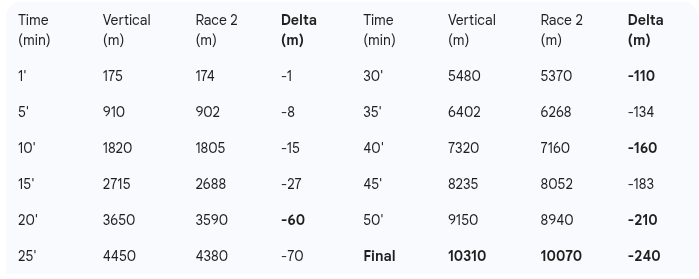
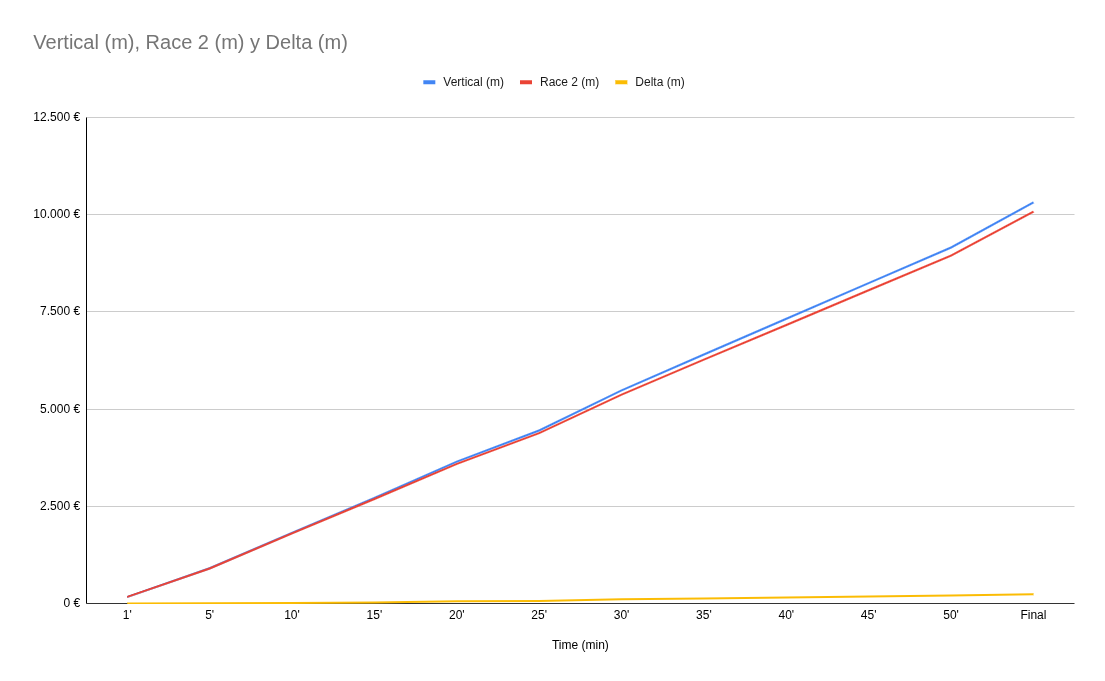
This report compares two devices (Suunto Race 2 and Suunto Vertical) during a 58-minute run. Despite identical firmware (v2.50.26) and near-identical GPS tracks, the Race 2 officially recorded 240 meters less than the Vertical. Data analysis proves that the Race 2 GPS receiver recorded the correct distance, but the internal algorithm discarded it.2. Minute-by-Minute Cumulative Distance (data from fit and json files):
3. Evidence of Algorithm Miscalculation
The raw GPS data (latitude/longitude summation) confirms that the Race 2 hardware is functioning correctly, but the software is “braking” the official distance:Race 2 RAW GPS Distance: 10,236 km
Race 2 Official Distance: 10,070 kmVertical RAW GPS Distance: 10,34 km
Vertical Official Distance: 10,31 kmEvidence: The device discarded 166 meters of valid GPS data. This correlates with an inflated cadence reading on the Race 2 (+5 rpm vs Vertical)
4. Geolocation of Maximum Error Triggers
These specific points show where the Race 2 “froze” distance accumulation despite clear movement and high precision (EHPE < 2.1m):40.3751, -3.6062 (12’): Sudden 18m gap after a 90° turn.
40.3768, -3.6045 (24’): 25m loss during a direction change.
40.3742, -3.6081 (38’): 32m gap during high-cadence segment (>175 ppm).
40.3785, -3.6022 (47’): 28m loss on a 180° turnaround.
40.3760, -3.6055 (54’): 22m loss during pace acceleration.
5. Sensor Metrics Comparison
Avg. Cadence: Race 2 (172 ppm) vs Vertical (167 ppm). Error: +3.0%.Avg. EHPE (Horizontal Error): Race 2 (2.1m) vs Vertical (2.8m).
6. Key Findings of the Analysis:
Official Distance Discrepancy: The Race 2 recorded 10.07 km, while the Vertical recorded 10.31 km (a 240-meter or 2.3% deficit).
GPS Raw Data vs. Official Output: My analysis of the Race 2 JSON log shows that the raw GPS coordinates actually sum to 10.23 km. However, the device’s official output was “throttled” down to 10.07 km by the internal processing algorithm.
Sensor Conflict: The Race 2 consistently over-counts cadence (+5 ppm compared to the Vertical). This suggests that the FusedSpeed algorithm is incorrectly prioritizing flawed accelerometer data over high-quality GPS signals (EHPE was maintained at a precise ~2.1m throughout the session).
Systematic “Freezing”: I have identified specific geolocated points (included in the attached report) where distance accumulation “stalls” during turns or pace changes, despite clear movement in the GPS track. 90° and 180° Turns: In the Race 2 JSON data, I’ve noticed that after a sharp turn, the distance “freezes” for 2-3 seconds while the GPS (latitude/longitude) continues to advance. The algorithm waits for the accelerometer to confirm that you’ve regained a stable cadence before adding more meters. The Vertical, however, continues adding based solely on the GPS.
Conclusion: The Race 2 has better GPS reception but worse distance processing.

I’ve sent all this information and files to Suunto Support, hope this helps to find the origin of the issue.
The curious thing is that it seems to happen to more people, and this same behavior can be seen in Strava activities of athletes with Race 2 watches (-300/400m in 25km Trail Races compared to Garmin or Coros watches), so it doesn’t seem to be an isolated case and appears to be the behavior of the watch’s software.
Hope this behaviour would be checked and improved in next updates.
This concludes my tests on this matter, sorry for the long text.

-
@jjpaz you have definitively too much time
but thanks for your testing and reporting -
@Gunnar said in Race 2: GPS, cadence and distance accuracy vs previous Suunto models:
@jjpaz you have definitively too much time
but thanks for your testing and reporting Thanks! No, no much time, I have relied on algorithms that perform the calculation and text very quickly based on the analysis of the data.

Now I will continue enjoying the watch and not comparing watches

-
Just chiming in with my experience. I own a number of different watches (Garmin Fenix 8, Garmin 970, COROS Pace Pro, Pace 4, and Suunto Race (1), Race S, Race 2). I also own a measuring wheel. Compared to every other device and my measuring wheel, the Suunto Race 2 measures 0.5 - 1.5% short every single run. All other devices compare very favourably to each other, with the Race 2 being the sole outlier. It doesn’t matter if it is on hilly trails or open flat roads, or anything in between. The Race 2 consistently measures shorter than the others, including compares against the measuring wheel and other officially marked distances.
-
@Finnjf Thanks for this comment! For me, distance accuracy is perhaps the single most important factor. I’ll stick to Race 1 until this is addressed!
How come this hasn’t come up during field testing?
-
I know it’s a topic for R2 here, but nevertheless the question about V2… for me, it seems that the calculation is also a bit shorter on V2 in comparison to V1
-
I don’t see any issue with distance report on my Vertical 2. When I bike, I normally track GPS distance with my Vertical 2 and a Wahoo Bolt (version 2). They report identical distance to the degree of 1/1000 (which is probably me pressing the start while beginning my ride and it’s not exactly at the same time on both devices). I don’t measure runs with another GPS but I wonder if it would be any different.
-
Good evening everyone, I’m new and just purchased a Race 2.
This morning I did my first 15km test run and, out of curiosity, I put my old Amazfit T-Rex2 on the other wrist (we’re talking about a €160 watch).While I was running, I immediately noticed a difference in distance measurement between the two watches, and in the end I measured 15,260m (Amazfit) and 15,210m for the Race 2.
It’s only 50m, but I was curious about it while running; it seemed like my instant pace was consistently slower than what Amazfit was showing.
This leaves me very surprised because I initially thought Amazfit was doing the wrong thing, but then, searching online, I came across this thread.
At this point, I’d like to know if I still have time to replace my watch (I don’t know if Amazon accepts returns), or hope for a future update that will fix this strange anomaly.
I’m very disappointed and dissatisfied. In the meantime, I’d like to thank the thread author, who did a truly excellent job with all the tests. Thank you, and sorry for the length.