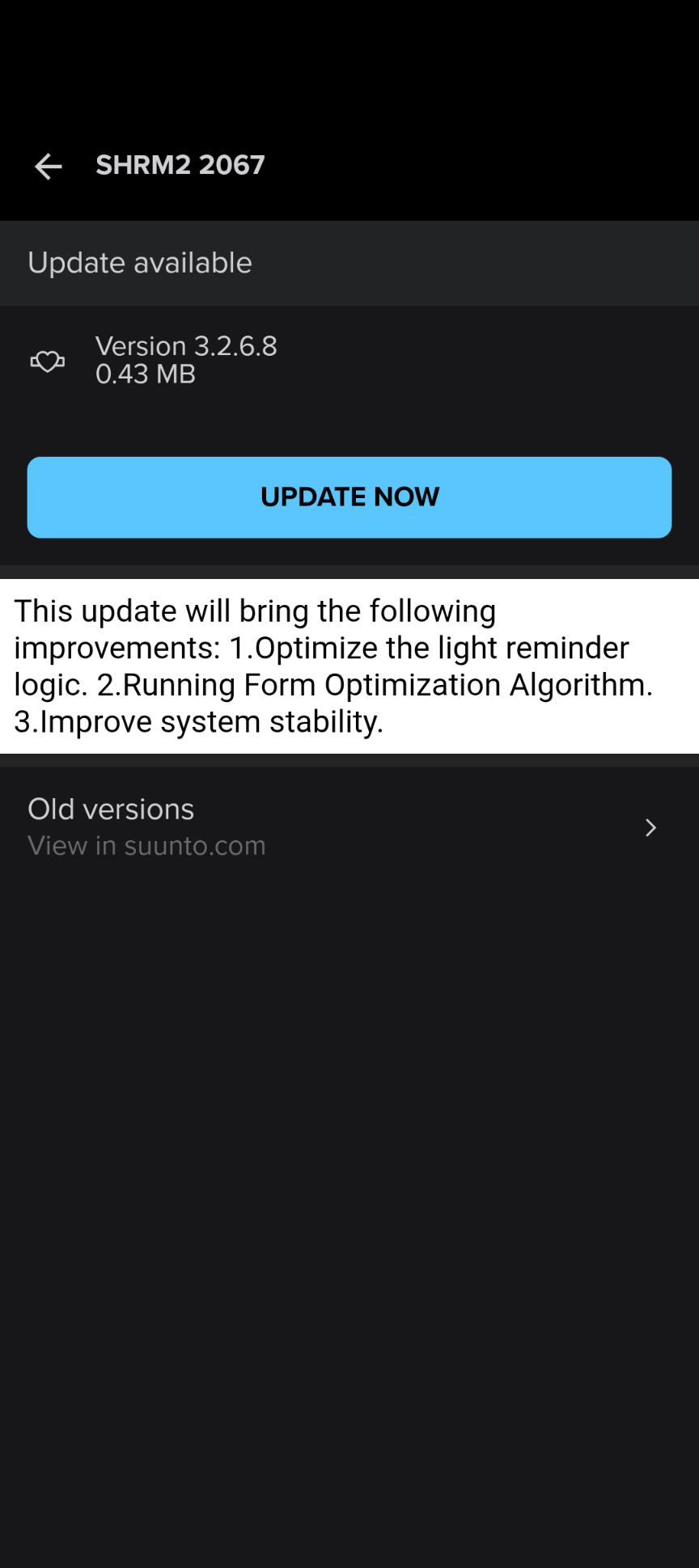
Suunto SHRB2 Firmware 3.2.6.8 Update
-
the flight times no longer work 45 ms the previous outputs were at 290
they’ve probably changed the FT (FT = Duration of a single step - GCT) calculation and imo it’s not wrong when viewed in the context of the other data e.g. see @atoponce math (well, there’s still something that needs to be fixed, since @inge-nallsson’s FT value is 0…)
-
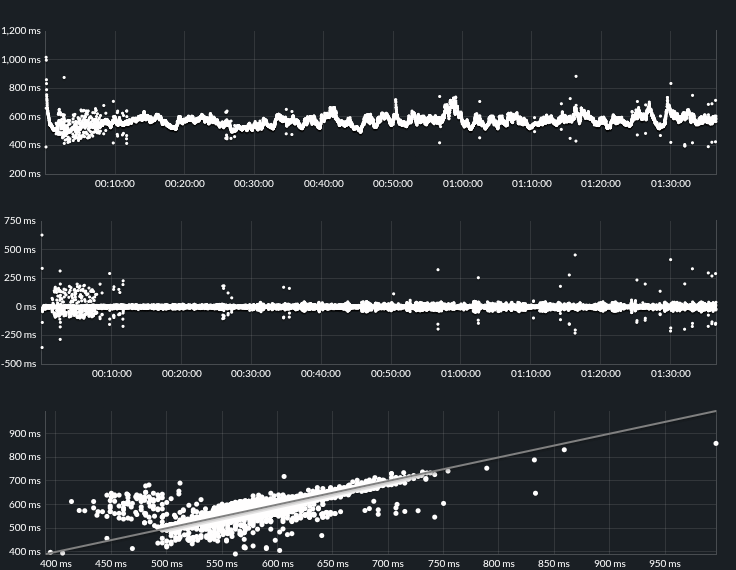
About on par for me when it’s not shielded. Although 0.0% anomalies, which is different. This was a trail run with friends.
-
A bit more input from my side. A run today of mixed-pace short intervals. Data with 3.2.6.8 FW and compared to Stryd Duo.
The overall run
Metric Suunto Stryd Step Cadence 150 151 GCT 435 457 FT 1 N/A GCT:FT 2419.1% N/A GCT * Step Cadence / 60 (= Duty Factor) 1.09 1.15 The formula for Duty Factor (DF) assumes that GCT is per individual foot. Which in this case means I am mostly walking, GCT > Step time.
Let us compare some intervals at a higher pace to see how they differ. I am using only Suunto numbers here. I can provide Stryd if it is of interest.
Interval Pace Cadence GCT DF Note 4:10 208 297 1.02 This is a 30s interval for me 5:15 176 347 1.02 This is about VO2max pace for me Full disclosure, I am 70+ years old. Not especially fast. My running style is fairly flat. I have run mostly half marathons and full marathons during my 25 years of running.
My current absolute max pace is 3:30. But based on the duty factor numbers it looks like I would still be walking

-
I reset the belt and tried again over 10 minutes and the flight time returned to normal 245 ms suunto updates are deplorable forced to reset everything after each update show included
-
@matram interesting.
Your GCT is 435 mS, while the step duration is 400 mS. It seems that when the GCT is greater than the step duration, the FT becomes 0 or so as if to tell you that you are “always” in contact with the ground.
same applies to @inge-nallsson e.g.
GCT 337mS
Step cadence 180 so step duration is 333mSAgain GCT > SD
Does that make sense?
-
@ggrego
Just to clarify. I did a factory reset after the update of the FW and had to re-pair the belt with my iPhone and Watch. This took several attempts.My old Polar H10 updated FW more easily and cleanly.
-
@snow
Maybe, I could buy that for a very slow recovery run at 7 - 8 min pace.But 4:10 pace is very close to my absolute limit and it sure does not feel like I am speed walking.
But it seems like I am in good company with other walkers

It comes back to, if GCT is for one foot per step or for both feet per stride, the rest follows mathematically. I guess Suunto should provide an authorative answer to clear up the confusion.
-
Hello, did he notice that since the update the belt remained on standby? It no longer cuts. The sensor connects directly to the watch even without being attached to the strap
-
@ggrego The device will automatically turn off after 3 minutes without contact with the module.
-
Not for me it remains active even without the strap after several hours
-
A correction to my previous post first. The formula I used, GCT × step cadence / 60, gives GCT / step time, not duty factor. Duty factor is defined per stride (two steps):
Duty factor = GCT × step cadence / 120 (GCT in seconds)
So the boundary for “no flight phase” is DF = 0.5, not 1.0. My conclusion that GCT > step time was still correct for those numbers, but the numbers were wrong.
I analysed Suunto (FW 3.2.6.8) and Stryd Duo FIT files second by second and looked at each workout segment, skipping the first 6 s of the 20 s intervals and the first 10 s of longer
Segment Pace spm GCT Suunto GCT Stryd Flight Suunto Flight Stryd DF Suunto DF Stryd Easy (10 min) 8:06 157 436 425 −51 −42 0.57 0.55 20 s interval 3:51 211 250 224 +49 +61 0.42 0.39 20 s interval 4:12 202 263 239 +39 +58 0.43 0.40 90 s interval 5:22 178 344 309 −5 +29 0.51 0.46 Walking recovery ~11:00 110 ~470 ~650 +75 −110 0.44 0.60 (GCT and flight time in ms. Flight time = 60 / cadence − GCT.)
What I see:
- Suunto’s GCT lags about 6 s. At the start of each interval it holds the previous walking value (480 ms) for several seconds before dropping to about 245 ms. In a 20 s lap this pulls the lap average up a lot, which explains the 297 ms I reported earlier. The steady part of that interval was about 245 ms, with a clear flight phase.
- When running, Suunto’s GCT is about 25–35 ms longer than Stryd’s. Near the boundary that’s enough to turn a positive flight time negative: −5 ms versus +29 ms in my 90 s interval.
- During walking, Suunto shows a near-constant 465–480 ms and positive flight time, which can’t be right for walking. Stryd shows about 650 ms (DF 0.60), a normal walking value. It looks like Suunto’s GCT isn’t measured directly in that range.
- At easy pace, both devices agree that I have no flight phase (DF about 0.55). That’s not walking, though. It’s “grounded running”: running mechanics, with the body lowest at midstance, but one foot touches down before the other leaves. It’s common at slow paces, especially for us older runners.
So for anyone puzzled by odd flight times: check the second-by-second data and skip the start of any short laps before drawing conclusions. Over longer steady segments, Suunto and Stryd are fairly close, with Suunto reading somewhat longer GCT.
-
One aspect of this device that I’m interested in is the information related to vertical oscillation. It’s an area that I think I need to improve (more forward motion and less ‘up and down’) but that is based on the data generated by the Garmin 955 that I sometimes wear. I noticed that in the comparison between SHRB2 and a Garmin 955 (a few posts earlier) the latter showed a higher number for VO, compared to the Suunto device. This makes sense to me, as it must surely be more difficult to measure this characteristic using a device that’s being swung back and forth, whilst simultaneously going up and down, compared with something that’s fixed to the torso.
Have any other SHRB2 users, that are in a position to compare with wrist based data, seen a similar result? I ask because no matter how ‘carefully’ I run, the Garmin 955 still says I’m bobbing up and down like pogo stick!

-
Have any other SHRB2 users, that are in a position to compare with wrist based data, seen a similar result?
I found the same. Garmin (Epix Pro and Fenix 8 in my case) gives a bit more than the HRM2. It is 8.x vs. 7.x cm in an easy steady run for me. Hard to say what is closer to the truth…
-
@wakarimasen
These are some typical values for me …Device VO (cm) Race 2 from wrist 6.3 SHRB2 from chest 5.1 Stryd Duo from foot 5.7 Which value is correct is not obvious to me.
-
Have any other SHRB2 users, that are in a position to compare with wrist based data, seen a similar result?
I found the same. Garmin (Epix Pro and Fenix 8 in my case) gives a bit more than the HRM2. It is 8.x vs. 7.x cm in an easy steady run for me. Hard to say what is closer to the truth…
@wakarimasen
These are some typical values for me …Device VO (cm) Race 2 from wrist 6.3 SHRB2 from chest 5.1 Stryd Duo from foot 5.7 Which value is correct is not obvious to me.
Thanks both! For me it makes sense the wrist-based measurement would be higher, but of course it’s just a guess in the end.


Hello! It looks like you're interested in this conversation, but you don't have an account yet.
Getting fed up of having to scroll through the same posts each visit? When you register for an account, you'll always come back to exactly where you were before, and choose to be notified of new replies (either via email, or push notification). You'll also be able to save bookmarks and upvote posts to show your appreciation to other community members.
With your input, this post could be even better 💗
Register Login