Vertical 2 during 14.5 hour long ultra
-
@maszop said in Vertical 2 during 14.5 hour long ultra:
Suunto maps, despite lacking many details, look much better.
Suunto maps only look better, but are much less usable if we forget for a moment about the navigation layer on top of the map. Consider the map itself. But I would question even the “look better” part. For example consider this screenshot from my weekend trail run and imagine looking at that not on a large screen but on a small watch screen at a distance of extended arm and while running:
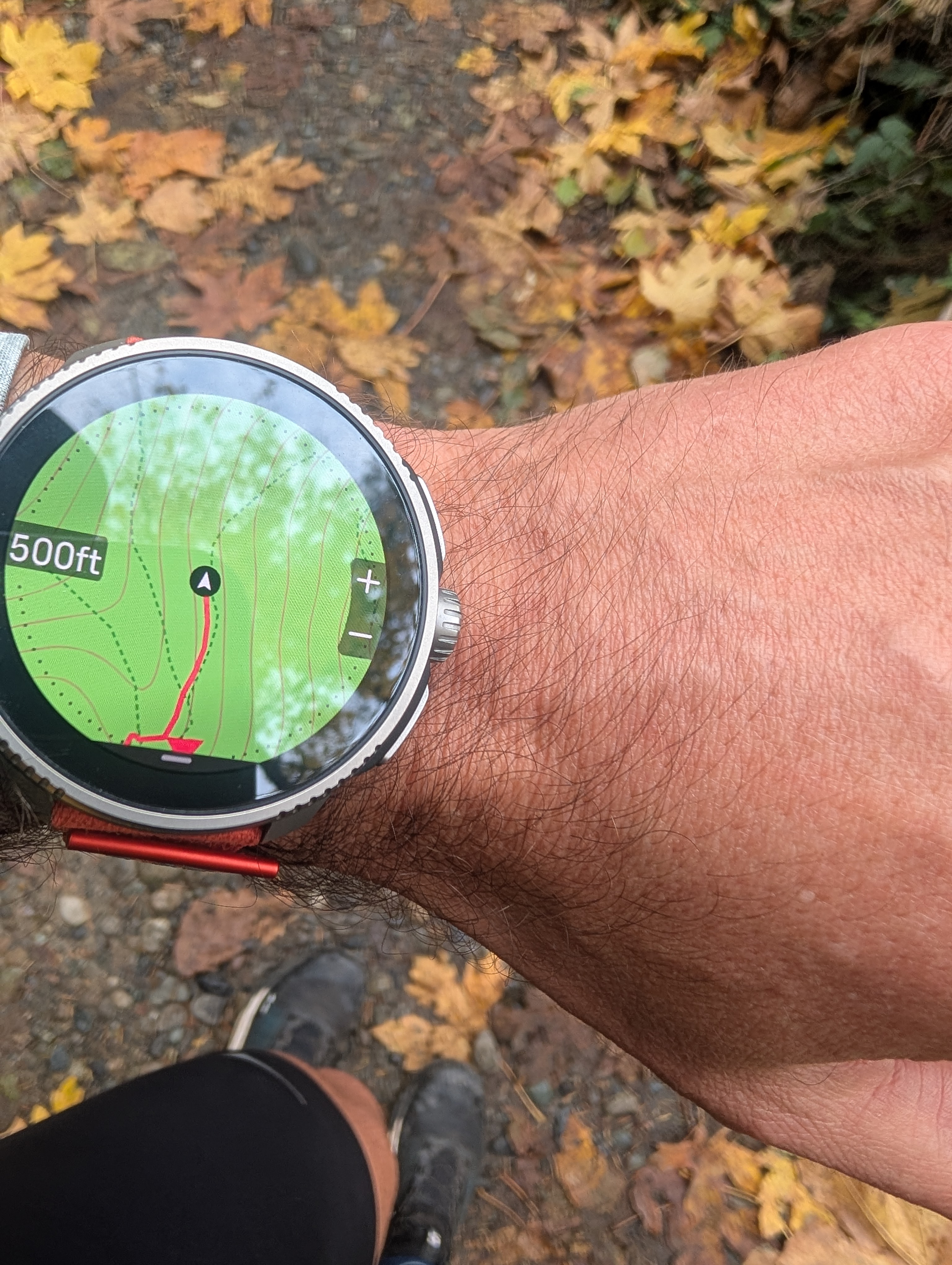
Can you even see what I am talking about? Who thought that rendering trails as green on a green was a good idea? And I don’t even mention that one more zoom out and I’d be staring at a pure green screen with zero details.
-
@sky-runner I have already written here many times that Suunto maps become useless when viewing a slightly larger area. No trails, no paths, no contour lines – just breadcrumb on a colored background.
If there is a place with more landscape elements (lake, fields, cliffs, etc.) then Suunto maps look great.
Regarding your photo, I’ve been concluding for some time that the people responsible for the map’s appearance don’t actually use them in the field. Look at how cartoonishly clear these paths are in the city (they look like some kind of highway), and how difficult they are to see, for example, in your photo.
-
@maszop said in Vertical 2 during 14.5 hour long ultra:
Regarding your photo, I’ve been concluding for some time that the people responsible for the map’s appearance don’t actually use them in the field. Look at how cartoonishly clear these paths are in the city (they look like some kind of highway), and how difficult they are to see, for example, in your photo.
But what I find the most difficult to understand is that not a single reviewer has pointed to this when Race 2 and Vertical 2 were released. I mentioned this issue to two of them in advance, so they were aware, and they still didn’t mention it.
-
@sky-runner this is why I don’t watch review videos anymore. People act like they are the only source of truth and the holy grail. I find it amusing when somewhere online uses “but DC ray said” as an argument. They touch just the surface, show the user interface, show HR comparison on one or two activities, then conclude for whom this watch is. There are a few exceptions, but 90% of them are like that. In entertainment terms I would say it’s “lazy writing”.
-
I think the maps are very useful. But there needs to be said I come from no map on my previous watch (Polar Grit X), only a breadcrumb trail. I find it easy to determine my path and orient with it. The only thing I would ask is paths visible to 500 m or maybe 1 km. But that’s all
-
@Horizontal_2 said in Vertical 2 during 14.5 hour long ultra:
The only thing I would ask is paths visible to 500 m or maybe 1 km. But that’s all
I used to be that way until July 2025. Then Suunto has “optimized” it in the 2025 Q3 update, shortly before the release of Race 2. At least on my Race and Race S watches configured with imperial units, I could see trails at the 0.5 mile zoom level, which is 800 meters.
Can anyone from Suunto explain why this has been changed?
-
@sky-runner said in Vertical 2 during 14.5 hour long ultra:
Can anyone from Suunto explain why this has been changed?
No, the claim is Suunto doesn’t watch this forum…

-
@sky-runner
I am not sure where the claim that Suunto maps are raster-based comes from, maybe others have different definitions. But: The maps on my Race S are definitely vector graphics, not raster(=pixel) images. Just observe dashed lines while zooming for a clue. Map data clearly is split into tiles, though, which explains the lack of (difficulty to do) routing on the watch.My previous watch had no maps and I definitely find them useful despite their limitations, hoping that they finally fixed the “some tiles randomly won’t load” bug.
-
@jakubdr I was skiing 4 hours with 6% battery consumption, OHR on, best GPS, chest belt connected, slalom skis - it means many turns with arm raise to wake :-), so I am very satisfied with batery comsumption
-
@Jan_B said in Vertical 2 during 14.5 hour long ultra:
I am not sure where the claim that Suunto maps are raster-based comes from, maybe others have different definitions. But: The maps on my Race S are definitely vector graphics, not raster(=pixel) images
I am pretty sure this has been discussed before and the conclusion was that Suunto maps were raster based, and that’s why the maps are so much larger in size than Garmin maps and also that’s why rotation is so much more smooth.
However I started to research it last night and I am no longer sure. On one hand if you look at how building outlines scale, how multiple buildings merge together into formless blobs when scaling out, that points to image scaling. On the other hand, the way trails and roads scale, does no longer look like image scaling. I think that perhaps it now may be a combination of raster based and vector based layers, and that may also be the reason why rendering has changed in the 2025 Q3 update as discussed in https://forum.suunto.com/topic/13311/map-rendering-and-trail-visibility-after-software-update-2.43.8-.12 thread.
The Mapbox website does mention some innovation with Suunto and in particular this:
“The combination of Mapbox Tiles and Static Images API enables wristwatches map experience as effective as in mobile apps”
https://www.mapbox.com/showcase/suunto
Perhaps someone from Suunto who knows more details may shed some light if that isn’t a secret.
-
@sky-runner good find, but AFAIK mapbox is only used in the app, not on the watch…
-
Suunto watches are using vector maps data ofc
Opinions expressed are solely my own and do not express the views or opinions of my employer
-
And yes, mapbox provides some maps data only for Suunto App, not for watches
-
@pavel.samokha Very interesting!
If it is vector based it should be relatively easy to make the level of details optional for those users who really need it. The lack of trail visibility at higher zoom levels is something that is likely drive me to a competitor watch if that isn’t addressed soon. I find it bizarre that I can see building outlines at 0.5 mile zoom level, but trails disappear two zoom levels earlier. This is supposed to be an adventure watch so arguably trail visibility is far more important!
-
@sky-runner said in Vertical 2 during 14.5 hour long ultra:
If it is vector based it should be relatively easy to make the level of details optional for those users who really need it.
Exactly! Someone getting an idea to hide trails at 500m and above is weird enough, but that the idea actually makes it all the way to production firmware, unchallenged, is quite shocking.
-
@Squirrel as far as I know all digital maps show less details when you zoom out.
From my basic knowledge about this I would think, that otherwise you would not be able to distinguish individual paths in an area like this

-
@Egika said in Vertical 2 during 14.5 hour long ultra:
@Squirrel as far as I know all digital maps show less details when you zoom out.
From my basic knowledge about this I would think, that otherwise you would not be able to distinguish individual paths in an area like thisOf course it’s less detail when zoomed out, but how much less? The current algorithm is obviously flawed when you zoom out above 200m and suddenly you see nothing but a green background if you’re in the forest, as it happend to me recently.
-
@sorinus That someone made the decision to remove such key details as paths from the 500m view is a scandal. And even more so that it went through the entire cycle, from decision, implementation, testing and release.
-
@OutdoorMan My complaint with reviewers is the best of them are still only using them for maybe a couple-few weeks and most of the time they are using the device on pre-rollout or gen 1 software on devices that are not Garmin, Apple or Whoop which are their main devices. There are clear biases when a test watch only gets used for a limited amount of time.
To Suunto’s credit a huge amount of work went into the Vertical, Race and eventually Race S software. The Vertical when it came out to where it is now is not comparable. There are so many upgrades and efficiency fixes.
So most reviews are like this: they take the Garmin off for however long they have to do do the testing, do the writing and then go back to Garmin. Arguably using my above logic the pundits have a good understanding of Garmin and how they are progressing through bug fixes and upgrades but little or no clarity when it comes to other watches. If I were to judge each watch on only a couple to few weeks and then it goes in a box or back to the manufacturer then I would have a very jaded view of what is out there and how good the current sw is. Very very few are doing 6 month or 12 month follow ups because I would guess there is no money in it. Its is all about the money.
Also I would argue that it takes time to understand and build a relationship with a UI both on the watch and on the app. I know some of the pundits use TP, but most end-users are only going to use the app that the specific brand puts out with the watch.
The last limitation is silly, but what I don’t see another way around it. If you are one of these pundits that use Apple watches that means one wrist is always taken for that apple watch. You only have one more wrist to test with. Reviews might be a little different if they could commit to 4-6 months with a watch on their wrist, but I think this is impractical from their stand point especially considering the clicks and likes and views come from 1. Apple, 2. Garmin and then it slides very quickly to much much fewer. They are incentivized to only test and use those two watches.
I get it, they want to make Youtube a full time gig and most of them have wives and children so they need to make some kind of money from Youtube and arguably as quickly as possible. That means Garmin and Apple in the English speaking world is the easiest fastest way to monetize and we will never get a super clear view of how the “current” state of tech. The rewards of putting out a ton of reviews (ie money) will always disincentivize the pundit class from having a clear global understanding of the global sport watch ecosystem because the can are only long time users of the ones that make money.You may think I am being harsh, but I remember for the longest time on DC’s sale blogs there were only links to items that were affiliate links, Suunto would never get on the list regardless of how good the discount was. I am sure he would have a comeback to this comment, but I think we all do things that are sometimes subconsciously motivated by finance.
-
@Stavrogin People like DC Rainmaker have no initiative to be fully objective and unbiased. They do rely on receiving preproduction devices for reviews, which allows them to publish reviews on the release day, which drives a lot of traffic to their reviews and their videos. But if they were too critical of the devices and pointed out to flaws, they’d no longer receive preproduction devices in the future. So they are incentivized to be promoters rather than unbiased reviewers.







Hello! It looks like you're interested in this conversation, but you don't have an account yet.
Getting fed up of having to scroll through the same posts each visit? When you register for an account, you'll always come back to exactly where you were before, and choose to be notified of new replies (either via email, or push notification). You'll also be able to save bookmarks and upvote posts to show your appreciation to other community members.
With your input, this post could be even better 💗
Register Login