Subject: Feedback on Zone Sense accuracy: Short intervals and Zone 2 threshold shifts
-
I’ve been testing Zone Sense recently and wanted to share some detailed feedback regarding its behavior during specific sessions (treadmill and outdoor runs). I compared the Suunto data with Garmin’s LTHR-based zones and performed a deep dive into the raw HRV data.
Testing Conditions:
For these tests, I used a Garmin HRM strap paired simultaneously to both my Suunto Race 2 and my Garmin Epix Pro (Gen 2). This ensures that the heart rate and HRV (R-R intervals) data source is identical and highly accurate for both devices.- Short Intervals Visibility (Treadmill)
During 1-minute intervals at 13 km/h on the treadmill, Zone Sense remains almost “blind” to the intensity shift. Even with the accuracy of the chest strap, the rapid change in effort doesn’t seem to register within the algorithm’s detection window, likely due to the short duration of the burst. - Underestimation of the First Threshold (Aerobic)
During steady Zone 2 sessions (based on Garmin LTHR outdoor baselines), Zone Sense consistently marks me as being above the first threshold (moving into “Yellow/Red” zones in the app). - Data Verification
To verify this, I performed the following analysis:
• Exported the .fit files from both Suunto or Garmin.
• Converted them to .csv via fitfileviewer.com to access raw R-R intervals.
• Analyzed the data through a specialized AI model to identify physiological breakpoints.
The result: The raw R-R intervals confirm that for the Zone 2 session, my heart rate variability markers stayed well within the aerobic zone. I never actually crossed the first threshold, which contradicts the current Zone Sense interpretation. It seems the algorithm is currently too “conservative” for my profile.
Has anyone else noticed this bias regarding the first threshold or a lag in detecting short, high-intensity intervals? I’m happy to share further data if it helps the dev team!
- Short Intervals Visibility (Treadmill)
-
@Dieter1960 doesn’t the documentation state that ZonseSense cannot detect short intervals at all?
-
@Dieter1960 If you read the documents and watch the videos, you will gain answers to your questions. ZS is ineffective on short intervals, I personally would not use on any interval less than 20 min or so. There is a lag of 1 to 2 min for ZS to implement changes.
For AT I have tested ZS prior to the public release and since then (for over 1 year) and for me I get both AT and LT accurately but only if I spend significant time in HR zones at or above AT and LT. ZS is primarily intended for live values and its ability to detect zones will depend on how recovered you are. On days I am well recovered for example, after a recovery week, I get AT values near my lab measured values. On days where I am in a training block my AT from ZS can be 20bpm lower than my measured values.
So:- Don’t use 1 or 2 exercises to calculate either AT or LT, a lot are required for me.
- ZS is an excellent measure of RPE for me and for some others on the forum.
In my opinion you are asking for ZS to do something it is not intended to do. I doubt the AI analysis is as good as the algorithms (patented) that ZS uses from Monte Cardio (not sure that is correct.)
You can search the forum for a lot of discussion on ZS.
Vector/T6c/Vertical 2 Ti
-
Thanks for sharing such a detailed feedback. Your experience as a long-term tester brings a lot of clarity to how Zone Sense (ZS) actually behaves in the field.
A few points you mentioned really resonate:
• The Lag & Stability: You’re spot on about the 1-2 min delay. It confirms that ZS is a physiological tracker rather than a real-time reactive tool like pace or power. It’s clearly not built for short bursts.
• Fatigue vs. Lab Values: Your observation about the AT dropping by 20bpm during heavy training blocks is a perfect example of what ZS is meant for. It tracks daily physiological capacity rather than theoretical fitness. It’s more of a ‘form’ gauge than a fixed calibration.
• Consistency: I agree that judging ZS on a single session is a mistake. It takes time and a significant volume of data in the higher zones to see the patterns emerge.
Using it as a dynamic RPE guide instead of a rigid zone system seems to be the most effective way to use the technology. Thanks for the heads-up on the algorithm origins as well ! -
Monitara
-
@Dieter1960 to expand on this, there is a Lecture Series of YouTube videos done by Suunto. There is lengthy talk about the Training model of Suunto and ZoneSense even with a guy from Moni Cardi (if I got the name right), that highlights the dos and don’ts…
-
@Dieter1960 said in Subject: Feedback on Zone Sense accuracy: Short intervals and Zone 2 threshold shifts:
Underestimation of the First Threshold (Aerobic)
During steady Zone 2 sessions (based on Garmin LTHR outdoor baselines), Zone Sense consistently marks me as being above the first threshold (moving into “Yellow/Red” zones in the app).This is my experience as well. I stopped caring about ZoneSense altogether because it consistently detects both LT1 and LT2 way too low. It sometimes detects LT2 at a HR that is even below my aerobic (LT1) threshold. Perhaps I use it not the way I am supposed to, but if it is too difficult to use correctly, why should I bother?
-
@sky-runner I agree
-
I see a very big difference in ZS feedback based on the sport. If I do XC skiing, it says my LT1 is 158 bpm. If I do treadmill running, it says my LT1 is 128 bpm. My breathing pattern tells me my LT1 is around 142 bpm. ZS is basically ± 15 bpm for me. It’s not enough for consistent training and is still not a replacement for a lactate meter. I understand the point about day to day variability, but going from 158 bpm to 128 bpm next day seems unrealistic. I wasn’t collapsing or anything, just the usual microcycle.
-
I totally agree. While daily variability is a physiological reality—especially with factors like fatigue or heat—a 30 bpm swing is simply unrealistic.
Zone Sense should use a rolling average or a baseline from your previous sessions. It shouldn’t ‘start from scratch’ every time you switch sports. Even if the internal load differs between XC skiing and running, the algorithm needs a memory of your history to stay consistent. Without that anchor, the data becomes too volatile to trust for daily training. -
@Brad_Olwin said in Subject: Feedback on Zone Sense accuracy: Short intervals and Zone 2 threshold shifts:
ZS is primarily intended for live values and its ability to detect zones will depend on how recovered you are
In that case ZS shouldn’t be used to detect zones but that is exactly what Suunto does. It remembers the last detected thresholds and tells me about them later. For example, a few seconds ago I looked at my watch and it showed me that my Lactate Threshold is 145, which is nonsense because that is just one or two beats above of where my AT is based on multiple years of observation. I can still mostly breathe through the nose at that effort.
-
@sky-runner Treadmill session this morning: 2 × 5 minutes at 12 km/h, with 14 minutes of warm‑up at 8 km/h before the first acceleration, 2 minutes at 8 km/h between the two fast intervals, and 2 minutes of walking at 6 km/h to make a total of 28 minutes.
First issue: the Suunto Race 2 couldn’t connect to the Polar H10. So I used the Garmin HRM 200 chest strap instead, and that worked fine. Clearly, pairing problems with chest straps still aren’t fully solved.
Zone Sense results: aerobic–anaerobic thresholds at 150 and 153 bpm, which doesn’t make sense. The 150 bpm aerobic threshold is consistent with Garmin’s zones. During the fast intervals I was in Zone 3, slightly below my lactate threshold. I think that’s why Zone Sense didn’t estimate the second threshold correctly — you need to go above it.
Conclusion: the first threshold is correct. Too bad that if I do an easy Zone 2 session tomorrow, it will probably calculate a second threshold that’s far too low. -
@Dieter1960 so, you have both thresholds calculated and they are only 3 bpm apart? Can you share a screenshot of this?
-
@2b2bff I too had thresholds detected at 3 bpm apart yesterday:
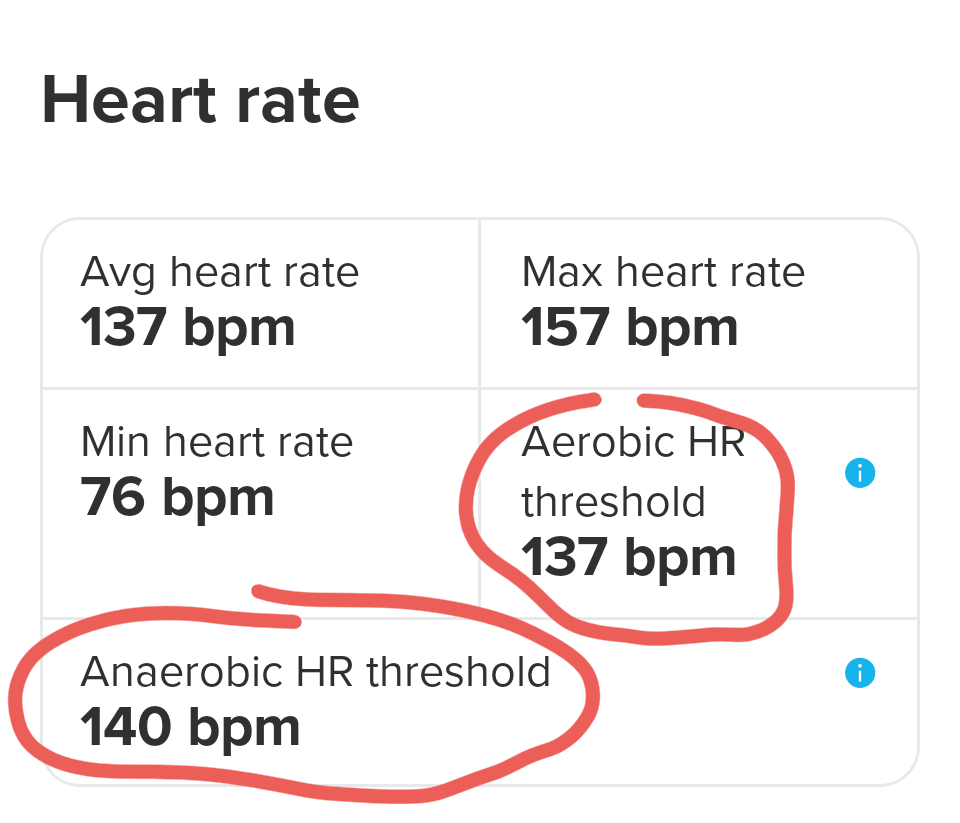
My actual aerobic threshold is at 143-144, so this is an example of ZoneSense detecting my anaerobic threshold below my actual aerobic threshold.
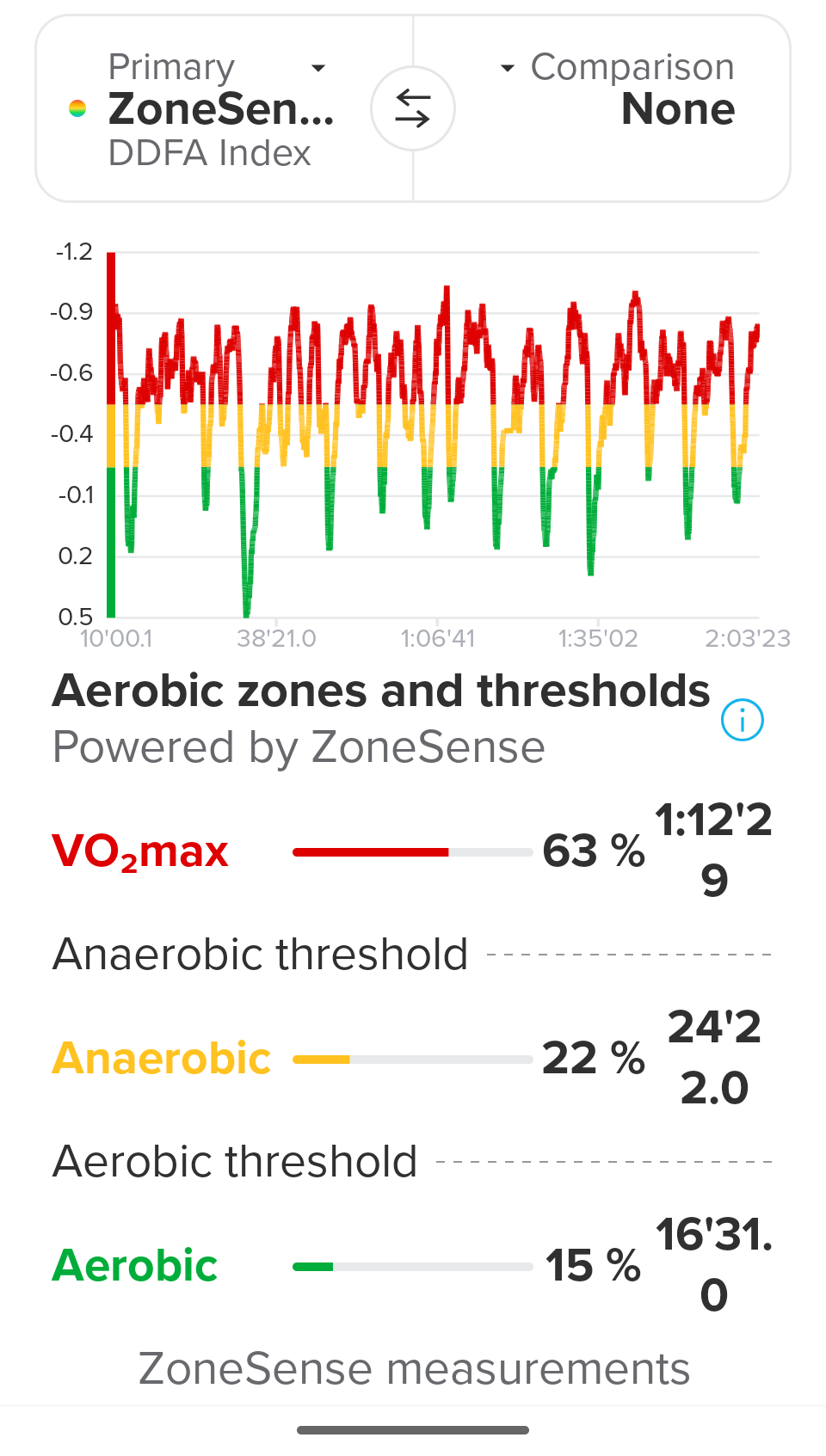
On today’s 2 hour run, which was a race like effort on hilly terrain it again detected my anaerobic threshold at 140, which makes total sense (that is a sarcasm) considering I was, according to Suunto, running at above anaerobic threshold for 63% of a 2 hour run.
Suunto: Ambit, Ambit 3 Peak, 9 Baro, Race S, Race Ti
Garmin: Forerunner 210, Forerunner 610, Fenix 6X, Fenix 7X Ti -
@sky-runner your graph does look absolutely useless, indeed. I wonder if you had 10 minutes easy effort to “warm up” ZoneSense…
It can be good, though. This has been a session of me with two segments pushing my threshold:

Graph looks good, but no detected thresholds have been recorded in the activity, what is odd.
-
@2b2bff I started to climb a steep slope 4-5 minutes into the run, and even though I walked the slope until about 10 minutes into the activity, my HR quickly raised to the top of zone 3. But arguably, ZoneSense shouldn’t be detecting thresholds in this situation.
-
-
-
Sent two images from Google Drive, don’t know if it works …
-
please, stop posting the same link. Attach the image here