Suunto Smart Heart Rate Belt 2
-
@cosme.costa said:
if I’m not mistaken Race do not have running metrics embedded in the watch.The information from the Suunto SHRM2 website states that running form IS available in Suunto race.
See screenshot here: https://forum.suunto.com/post/197873t6, S6, Elementum Terra, Ambit 3 Sapphire, Spartan Ultra, Traverse Alpha, S7 Graphite LE, S9B Ambassador, S9P Titanium, S9PP Titanium, Vertical All Black, Race Titanium, Race S Titanium Courtney, Run Lime, Race 2, Vertical 2 Titanium, Race 3s
-
My first run with the belt gave a 45% higher GCT from the belt
My only experiences with ‘running dynamics’ are from Garmin watches and peripherals, where the data differs significantly when it came from a pod placed at the back of running shorts/pants, a HR breast belt pod or directly from a watch. Ray Maker (dcrainmaker) wrote a whole essay about this fact several years ago.
Edit: Also have experience with two generations of Stryd foot pods (though not the latest which can be used on both feet to show ‘Balance’).
-
running form IS available in Suunto race.
The question was “embedded in the watch”. That is native. First generation Race and Race S does not have that…
-
running form IS available in Suunto race.
The question was “embedded in the watch”. That is native. First generation Race and Race S does not have that…
I currently don’t have a Race here, but you are saying, that the running form metrics are not recorded by Race and Race S?
Not sure what you mean by “native”. If the watch is receiving the extra data, then it is native. If the watch is not receiving the extra data, then it is not available (like in Vertical).
In between these two could possibly be an S+ app, that connects to the belt on a separate BT channel and reveives those data. That is, what I would call “not native”. Currently an app like this does not exist, afaik. -
but you are saying, that the running form metrics are not recorded by Race and Race S?
No, what I am saying (and how I interpreted the question), is that Suunto Run, Run2, Race2 and Vertical2 all have native running dynamics coming from sensors in the watch itself. They do not need the SHRM2 to show this data.
Race, and Race S both need the external hardware of an SHRM2.
Suunto Race S
-
@Inge-Nallsson
Thanks for the tip. Here is a link to dcrainmaker comparison if anyone is interested.https://www.dcrainmaker.com/2017/02/running-efficiency-showdown.html
There are for sure differences but not as large as what I was seeing. Mybe time to dig out my Stryd pods for a comparison.
-
@Inge-Nallsson Unfortunately, I haven’t tried using Dynamics yet, but I also understand that you need the S+ app to view real-time data on the watch. If you don’t use the S+ app, you can still view the data later in the SA.
-
@Egika This I know.
What I was trying to say is that the ability in the Race and Race S to read these metrics from the new HR belt was enabled in their last firmware update, the one that the SV1 didn’t receive. This makes me believe that can be enabled in the SV1 too. -
UPS dropped off my new Suunto Smart Heart Rate Belt 2 today

First proper test this evening. Really curious to see what Suunto got right this time — and what they didn’t

-
but you are saying, that the running form metrics are not recorded by Race and Race S?
No, what I am saying (and how I interpreted the question), is that Suunto Run, Run2, Race2 and Vertical2 all have native running dynamics coming from sensors in the watch itself. They do not need the SHRM2 to show this data.
Race, and Race S both need the external hardware of an SHRM2.
thank you for your patience. Now I understand

Now just to add:
The built in running dynamics of the watches have less metrics than the belt. -
Hi, I’m wondering if the additional data provided by the new belt is planned to be used for the running activity only, or if they will be implemented for other activities too
-
Here is a link to dcrainmaker comparison
Yeah, that is a good comparison between different (old) devices, though mostly foot-based. I also have memories of comparisons between wrist and other body placements of the sensors but perhaps I’ve muddled the memory into one single study…
What I distinctly remember from my own experiments is that terrain variation plays a big part when comparing wrist vs torso measurement (less between torso vs foot). Meaning better alignment the flatter and smoother the path. But your 45% higher GCT seems a bit excessive.
-
I tried my new belt today for first time for commuting to work with bike. Just 10 mins one way and everything was working perfect.
Only one question popped to my mind. Why can I see cadence on biking exercise? Does new sensor pick up some data from biking too? It’s not mentioned anywhere. I saw it afterwards In SA. I was wearing only belt and watch.
Suunto Vertical Titanium Forest
Suunto Vertical 2 Titanium Sage -
@Stefano-M64 nice question! IMO it would be really nice if Suunto implements something for swimming too 🤩
Suunto Race 1 and SuuntoApp on Android 13.
-
@Jugger said:
Only one question popped to my mind. Why can I see cadence on biking exercise? Does new sensor pick up some data from biking too? It’s not mentioned anywhere. I saw it afterwards In SA. I was wearing only belt and watch.I just checked a cycling activity from last Saturday. In the iOS app I cannot see cadence anywhere…
Where does it show up for you? -
@Egika I had also S+ ZoneSense and Gustin activated. I try it again tomorrow.
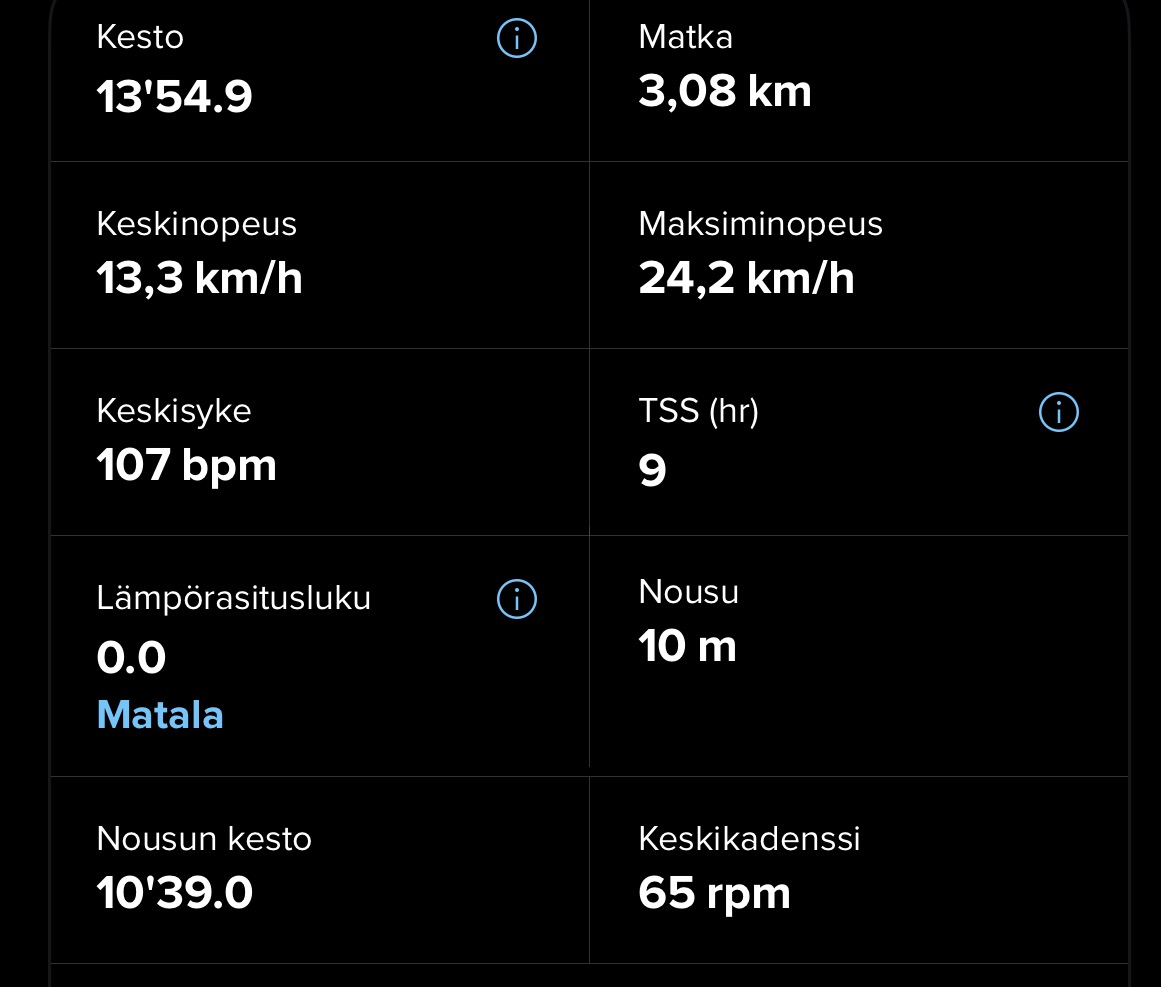
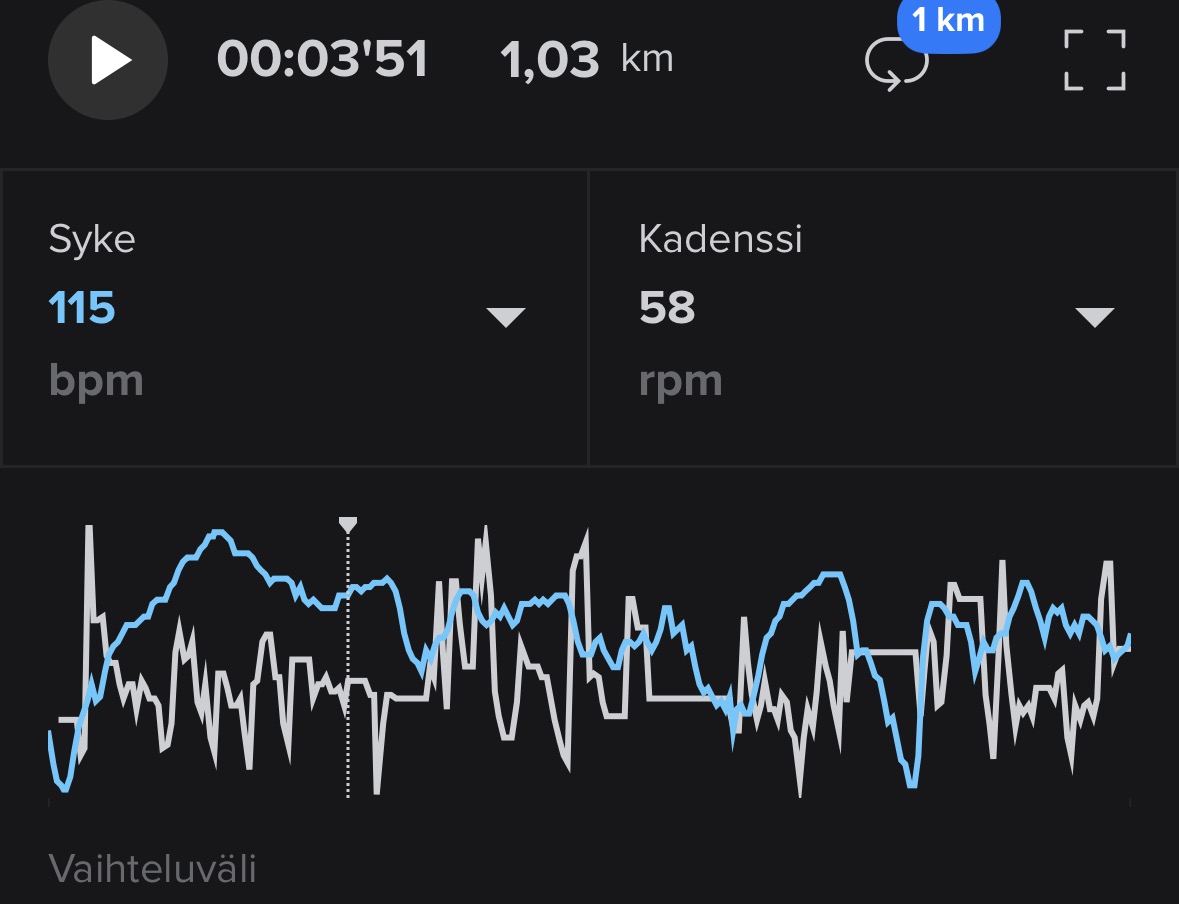
I have iOS with latest public update 3.14.1.
-
@Jugger interesting. I have 3.15 beta.
Maybe there is a difference. Or in the watch / belt firmware. -
@Egika Cadence should only be for running if I understand correctly. It would be hard for a HRM to be able to track your RPMs on a bike. That needs a sensor.
-
@SergioB And for XC Skiing - like Garmins XC Skiing Power

-
Mybe time to dig out my Stryd pods for a comparison
I could not resist the temptation, even though my injuries forced a really short experimental run. So, Suunto Race S connected to the SHRM2, Stryd ‘Wind’ (model Nr 19) pod on the left shoe (Altra Torin 7; a Zero-Drop/flat model) connected to the Stryd App on the phone, and finally Garmin Forerunner 955 with native running dynamics capability on the left wrist.
Total running session 1 kilometre in 7 minutes on practically flat asphalt (4-5 metres asc/desc). Cadence ca 175 spm, Average Ground Contact Time and Average Vertical Oscillation below:
SHRM2 – StrydW – FR955
354 ms – 319 ms – 273 ms
5.7 cm – 4.78 cm – 7.6 cm354 is 29.67% higher than 273 according to Google, and that is also the ca 30% difference I had in mind from old experiments. The Suunto info then says I’m either Fair: 270–300 ms or Poor: 300 ms. But I bounce around with the efficiency of an Elite: <6 cm or at least is Very good: 6–8 cm. I stopped looking at these numbers a long, long time ago…
The shockingly bad experience with the SHRM2 was the Heart Rate. Strap was firmly secured and wet before the run. This is either a serious pod firmware bug OR a Race S firmware bug:
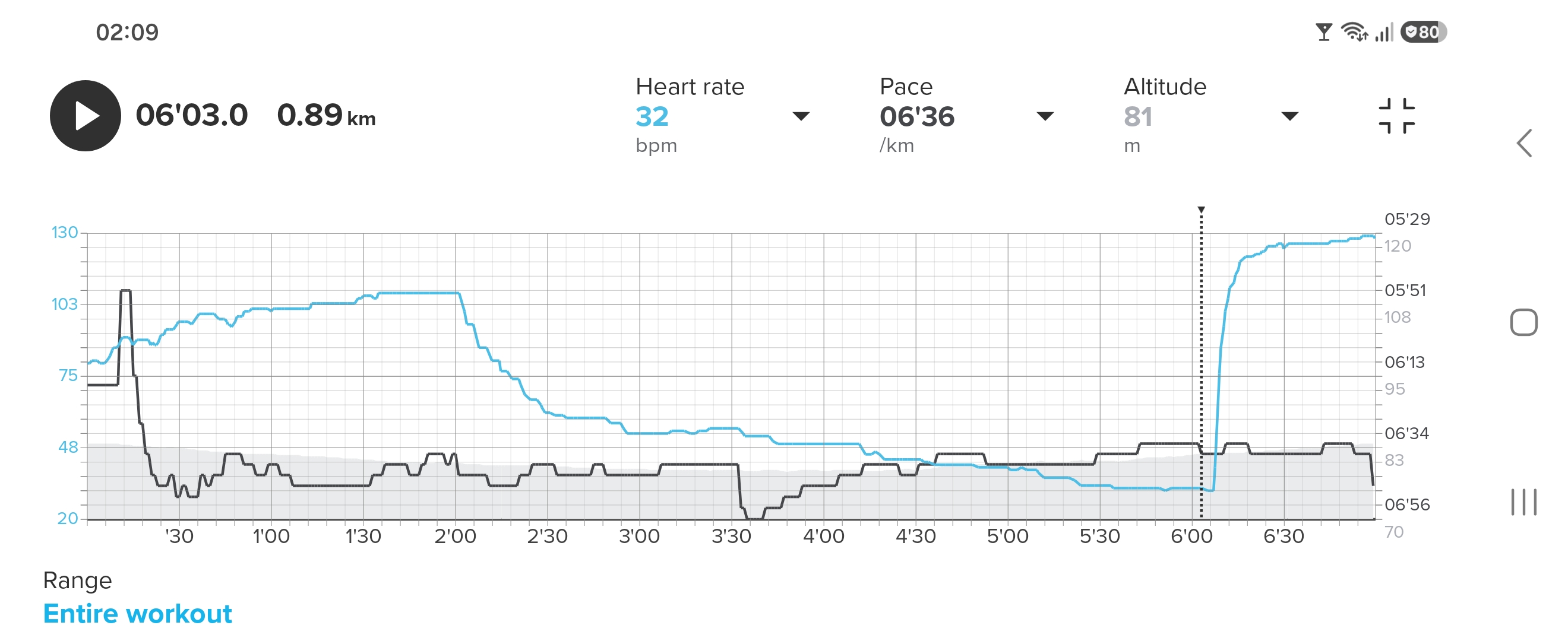
Look at that HR of 32 bpm! Even lower than the lowest I’ve seen while sleeping and wearing a Holter monitor (39 bpm).





Hello! It looks like you're interested in this conversation, but you don't have an account yet.
Getting fed up of having to scroll through the same posts each visit? When you register for an account, you'll always come back to exactly where you were before, and choose to be notified of new replies (either via email, or push notification). You'll also be able to save bookmarks and upvote posts to show your appreciation to other community members.
With your input, this post could be even better 💗
Register Login